The Ghetto Brothers and the Sound of a Bronx That Refused to Collapse
How a gang from the South Bronx helped create the conditions for hip-hop.
In France, when something is chaotic, disorganized, or completely out of control, people sometimes say:
“C’est le Bronx.”
It means: What a mess.
But the Bronx of the 1970s was doing something else entirely.
A little light listening for a Sunday (not ironic!).
Le Bronx
In France, when something is chaotic, disorganized, or a little out of control, people sometimes say:
“C’est le Bronx.”
It means: What a mess. or chaos, or something.
It’s not positive.
And I like the Bronx, but its got its issues for sure.
It’s one of those expressions that makes New Yorkers laugh a little. Or wince. Because the phrase comes from a very specific historical moment when the Bronx became shorthand for urban collapse. Burned buildings. Abandoned blocks. Violence. Poverty.
By the 1960s and 1970s, the word “ghetto” in the United States had largely shifted to describe racially and economically segregated urban neighborhoods, particularly Black and Puerto Rican communities shaped by redlining, housing discrimination, and disinvestment. In cities like New York, journalists and politicians increasingly used the term to describe places like the South Bronx, flattening complex neighborhoods into a shorthand for urban crisis.
But like most clichés, it flattens the story.
the little people
The Bronx in the early 1970s wasn’t just falling apart or on fire, it was also inventing things, a cultural factory.
Hip-hop. Block-party DJ culture. Graffiti as art. New hybrid forms of Latin music. Tons of other cultures came, combined, contributed, found and created voices for thousands of others that would follow.
Laid roots.
And right in the middle of that moment was a group that most people have never heard of.
They were the Ghetto Brothers.
When you think of the bronx, maybe think of this:
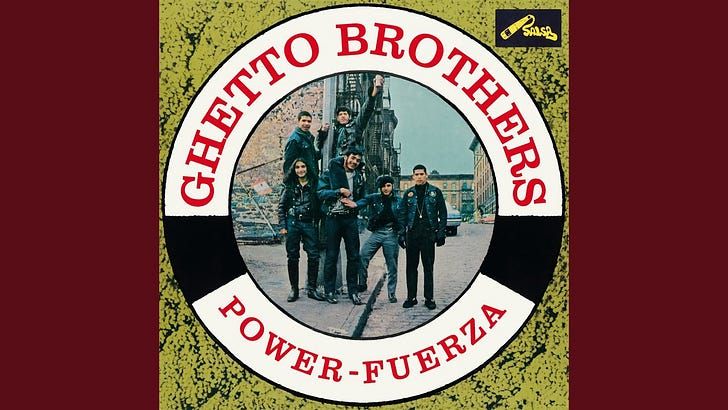
“If the Ghetto Brothers’ dream comes true, the world will learn that the ‘little people’ wish to be acknowledged, wish to be properly educated in order for them to pass on their knowledge to their children, and proudly inform them about their heritage and culture, and be a functioning part of the dream of America. If the Ghetto Brothers’ dream comes true, the ‘little people’ will be ‘little people’ no more, and make their own mark in this world. Listen to the Ghetto Brothers… and take heed.”—from the back cover of the original 1972 release of Power-Fuerza
Got This Happy Feeling — Ghetto Brothers (1970)
The Ghetto Brothers formed in the South Bronx in the late 1960s, in neighborhoods like Morrisania and Hunts Point, where Puerto Rican migration had transformed the borough. By the early 1970s, the Bronx held one of the largest Puerto Rican communities outside the island itself. That community had its own politics, institutions, and street organizations.
The Ghetto Brothers were one of them.
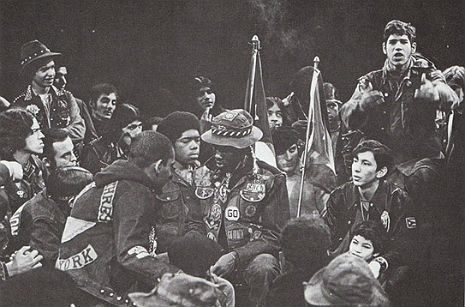
Their leader, Benjamin “Yellow Benjy” Meléndez, was both a gang leader and a guitarist, which tells you something about the moment. In those years, politics, music, and survival overlapped in ways that are hard to imagine now.
Power-Fuerza
And the Bronx was not just a battlefield of gangs. There were also peace movements and cultural consciousness movements growing across the borough. Groups like the Young Lords were organizing around housing, healthcare, and Puerto Rican identity. Community leaders were trying to channel the energy of the streets into something constructive.
The Ghetto Brothers were part of that current.
They were technically a gang. But they were also organizers, musicians, and neighborhood figures trying to steer things in a different direction.
Their 1971 album Power-Fuerza captures that moment perfectly. The music blends Latin rock, funk, garage guitars, soul harmonies, and Puerto Rican percussion. It sounds like the Bronx itself, where kids grew up hearing salsa, James Brown, and street corner doo-wop all in the same afternoon.
One of the standout tracks, “Got This Happy Feeling,” is almost disarmingly optimistic. Loose guitars. Hand percussion. A groove that feels half street party, half garage rehearsal.
By 1971, the Bronx was already being written off by the rest of the city. Fires were constant. Buildings were collapsing. Landlords were abandoning entire blocks.
And yet here were these kids insisting, against all evidence, that there was still joy in the neighborhood.
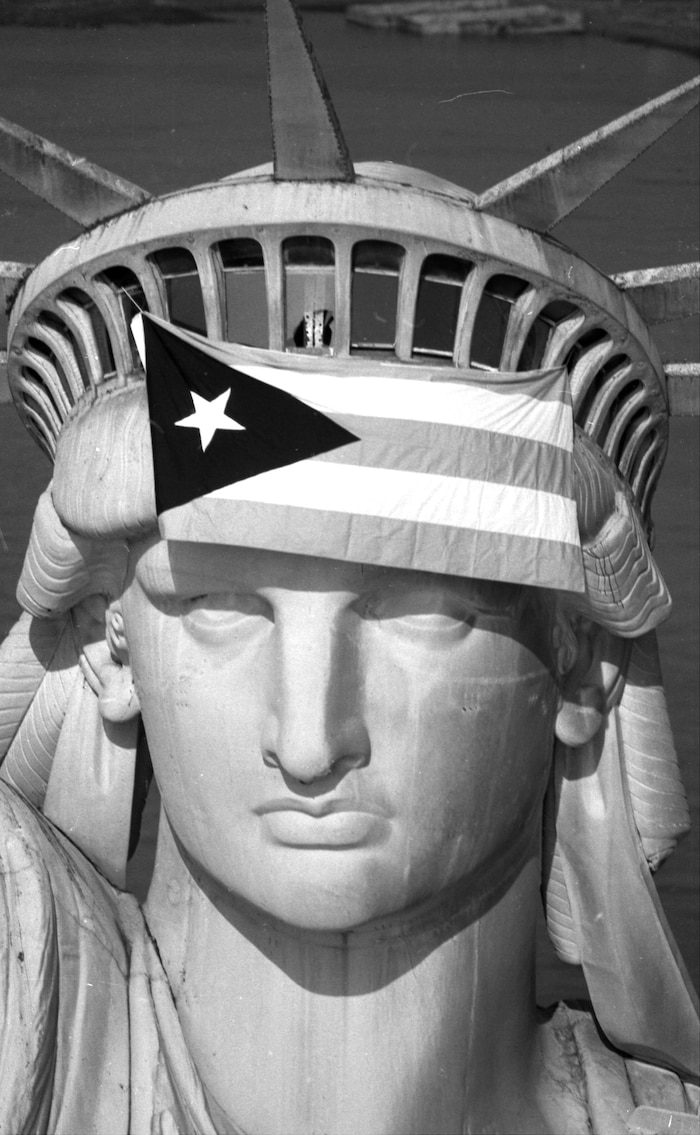
Viva Puerto Rico Libre
If “Got This Happy Feeling” shows the warmth of the Bronx, “Viva Puerto Rico Libre” shows its politics.
The title alone places the song inside the political energy of the era. The late 1960s and early 1970s were a period of intense activism among Puerto Ricans in New York. The independence movement on the island resonated deeply with communities in the city.
The Ghetto Brothers weren’t alone in that consciousness. The Young Lords were organizing garbage strikes and occupying churches to demand better services in neglected neighborhoods. Across the Bronx and the Lower East Side, there was a growing sense that Puerto Rican communities deserved political power, dignity, and recognition.
“Viva Puerto Rico Libre” is not subtle. It’s a declaration. A Bronx band shouting solidarity with the island.
But the political side of the Ghetto Brothers showed itself in another way as well.
In 1971, a member of the group known as Black Benjy was killed while trying to stop a fight between gangs. Instead of retaliation, Meléndez organized a meeting between Bronx gangs on Hoe Avenue.
The meeting produced a fragile truce.
That truce was part of a broader movement at the time. Community leaders, gang members, and activists were all trying—sometimes successfully, sometimes not—to reduce the constant violence tearing through neighborhoods.
And the truce did something unexpected.
It created space.
Space for block parties.
Space for music.
Space for teenagers with speakers and turntables.
One of those teenagers was Afrika Bambaataa, who would later help shape hip-hop culture.
The peace treaty didn’t invent hip-hop.
But it helped make it possible.
community
I know the Bronx reasonably well.
But I didn’t grow up there.
The Bronx was where I spent the last few years of my teaching career in New York. First in Riverdale, up on the hill. Later in a school in the South Bronx.
In a lot of ways, the people are the landscape of a big city. One thing that always struck me about my students was how well they knew people — how well they could read them. Far better than I could at their age. They saw a lot. They watched. Maybe not all of them, but many did.
Those are two very different places separated by just a few subway stops.
under pressure
And while the South Bronx still faces real challenges, the phrase “C’est le Bronx” misses almost everything that actually matters about the place.
Because when people say that, they imagine chaos.
What they don’t imagine are homes.
Or families.
Or communities that have been there for generations.
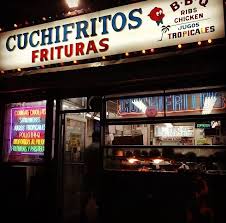
They don’t picture the parks where grandparents sit in folding chairs, the Dominican & Puerto Rican lunch counters, the murals that quietly tell the history of the neighborhood if you stop and look.
And they definitely don’t picture the kids.
The South Bronx is full of really cool little kids. Smart, funny, observant, and very aware of the world around them.
If you spend enough time teaching there, you start to understand something important.
The Bronx has always been a place that produces culture under pressure.
Hip-hop came out of those blocks. Salsa flourished there. Graffiti turned into a global art form there.
And long before those things became world culture, they were just neighborhood experiments. Kids trying things out. People building something meaningful in a place the rest of the city had already decided was finished.
That’s why the story of the Ghetto Brothers matters.
Because even in the hardest years of Bronx history, people were still organizing, making music, and imagining something better.
Viva Puerto Rico Libre — Ghetto Brothers (1970)