Os Mutantes and the Beautiful Chaos of Tropicália
Os Mutantes, Jorge Ben, and the Beautiful Chaos of Tropicália

Some psychedelic songs stretch out into cosmic jams. Others pile on distortion until the walls start shaking.
It feels a little strange to write about Os Mutantes, because in Brazil they’re practically unavoidable. But last week I was talking with a bartender in Porto who had been playing Portuguese prog rock for an hour and had never heard of them. That surprised me.
So here we go.
TL;DR
Os Mutantes took Jorge Ben’s breezy samba-pop song “A Minha Menina” and, within a year, rewired its DNA into one of the great psychedelic pop recordings of the 1960s. The transformation captures the spirit of Brazil’s Tropicália movement, where artists mixed rock, samba, and avant-garde experimentation while working under the country’s military dictatorship.
Mutantes
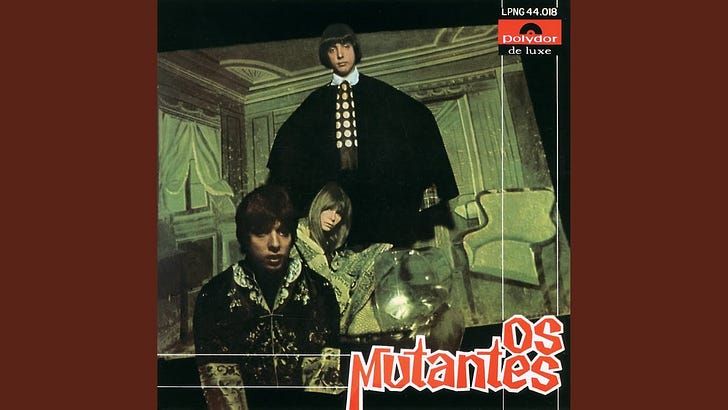
If you’re Brazilian, you may already know Os Mutantes. They’re one of the great psychedelic bands of the 1960s, and they went on to make adventurous rock and prog records for the next five decades.
They were central to one of the most inventive musical revolutions of the era (Tropilcália) and built a career that stretched across generations.
It may simply be that I spend too much time in the anglophone musical universe.
A Minha Menina — Os Mutantes (1968)
The version most people know appears on the band’s 1968 debut album Os Mutantes. The song itself began with Jorge Ben, who recorded it the year before. His version is relaxed and breezy, built around samba-pop rhythm and a loose, soulful vocal.
When Os Mutantes got hold of the song barely a year later, they altered its DNA.
They kept the melody and structure but rewired everything around it. Fuzz guitars crackle. The rhythm keeps Ben’s breezy Brazialian core. Strange little studio tricks & early sampling (musique concrete) pop in and out of the mix. What started as smooth samba-pop suddenly collided with the psychedelic sounds happening in London and San Francisco.
Like Death (from Detroit, 1970), The Sonics, or Iggy Pop in the late ’60s— Os Mutantes were pushing rock into strange new territory before anyone had names for the genres to come.
A Minha Menina — Jorge Ben (1968)
Jorge Ben was already one of the most inventive figures in Brazilian popular music, blending samba rhythms with soul, rock, and street poetry. He’s been heavily sampled in the last decades and it’s well worth diving into his whole catalog as well.
It’s Ben’s composition turned inside out by one of the most inventive bands of the era. The melody stays simple while the band builds a kaleidoscope of fuzz, rhythm, and studio magic.
Os Mutantes formed in São Paulo around siblings Arnaldo Baptista and Sérgio Dias, with Rita Lee completing the original trio. They were young, curious, and completely uninterested in musical purity. Their recordings mixed fuzz guitars, tape manipulation, orchestral fragments, and odd sound effects with melodies that were often deceptively simple.
They sounded less like a conventional rock band and more punks who got access to a professional studio.
Ando Meio Desligado — Os Mutantes (1970)
Ando Meio Desligado is a kind of proto-prog moment made just as bands like Yes and Genesiswere still figuring out what album-oriented rock could be. The track drifts from psychedelic pop into odd structures, tape effects, and sudden stylistic turns that would soon define progressive rock. This style exploded internationally, reflecting the exploratory mindset of the LP era.
Mutantes approached this through the “everything at once” of Tropicália , blending high and low culture, Brazilian traditions, electric rock, avant-garde composition, and studio experimentation at the same time.
Across their career the band moved freely through psychedelic rock, Brazilian pop, samba, bossa nova, garage rock, orchestral pop, proto-prog, and electronic textures, often shifting moods within a single song. That Tropicália habit of stylistic cannibalism, happening in parallel with the rise of prog in Europe, is why their late-60s records still sound ahead of their time.At the time, Os Mutantes were still largely unknown outside Brazil, which makes this 1969 appearance on French television so unusual.
Os Mutantes- Panis Et Circensis & Bat Macumba (French TV-1969)
Mutantes on French TV in 1969, most likely on Dim Dam Dom. Brazilian rhythms slide into fuzz-guitar rock and avant-garde experimentation. The May 1968 protests (still the largest in France’s history) changed the cultural mood and TV producers were looking to connect to the youth audience.
Programs like Dim Dam Dom featured experimental rock, psychedelic visuals, and foreign artists. Now, more French media leaned even toward slightly experimental programming aimed at younger viewers.
Psychedelic pop was not just entertainment. It was also a reaction and an attempt to connect to the youth of France.
Tropicália/Tropicalismo
Alongside figures like Caetano Veloso, Gilberto Gil, Gal Costa, and Tom Zé, the band helped create one of the strangest and most inventive cultural moments of the 1960s.
Like a lot of cultures, Brazil had its own “pure” music or culture movements. Tropicália was a response: experimental, bizarre even. Electric guitars mixed with samba. Psychedelic rock collided with traditional rhythms. Avant-garde experimentation met radio-friendly melodies.
dictatorship
All of this unfolded under Brazil’s military dictatorship (1964–1985), the regime that came to power after the 1964 coup and imposed censorship, surveillance, and political repression across Brazilian cultural life.
Instead of straightforward protest, artists responded by scrambling expectations and mixing styles, quietly challenging cultural boundaries.
Many artists of the Tropicália movement managed to be hated by both the political left and the political right. They weren’t politically aligned, they were against the status quo. Yet much of the music of the movement was playful rather than confrontational.