The Onion Beneath the Recipe
On onions, soil memory, and a simple purée you’ll taste differently tomorrow.

What if your most comforting flavors—the ones you’ve trusted for decades—are quietly carrying something else?
This is a story about onions. And about memory, of people and of the soil. And about chemistry that didn’t stay in the field.
TL;DR
Onion purée is usually a supporting act—something you add for depth, not attention. This version pauses on it long enough to show how even the most familiar recipes carry more than flavor. We don’t list trace elements in our ingredients, but they’re part of the dish all the same.
The simplest ingredients carry the longest histories.
An onion cooked slowly—sweat → simmer → purée → finish—shows up in nearly every cuisine. It’s a baseline move. You don’t need a recipe. You just need time.
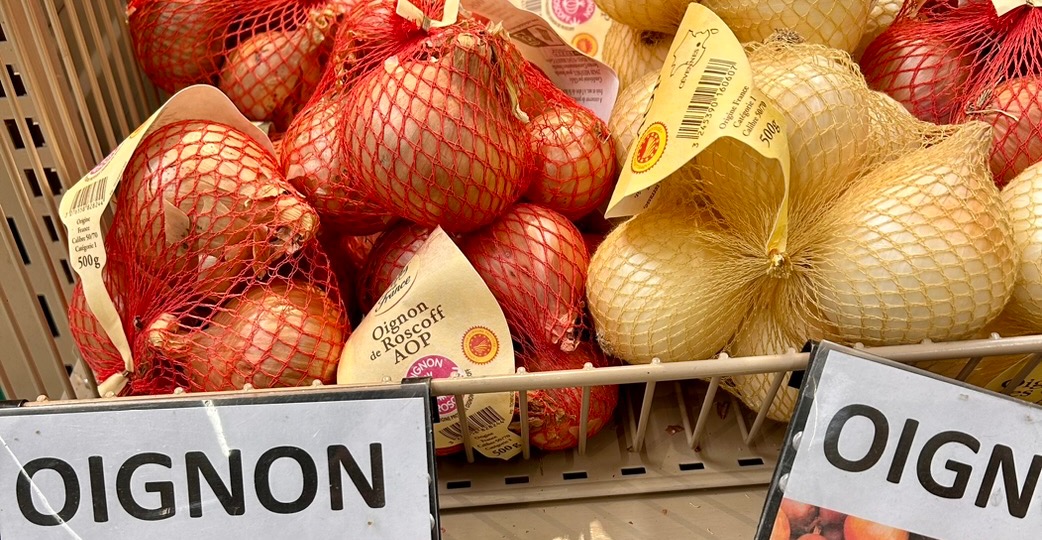
Ubiquity
Onions feel universal because they nearly are. Botanists trace them back to Central Asia 3,000 years ago (likely more) —dry ground, thin soils, places where plants survive by storing energy underground.
The bulb isn’t about refinement. It’s about the plant’s survival.
They spread early. Before recipes. Before cuisines hardened into identities. By the time empires form, onions are there—feeding workers in Egypt, traveling with Roman legions into Gaul, feeding people long after.
That’s why they appear everywhere.
Not because cultures borrowed from one another, but because onions solve the same problems wherever people live: stretch a meal, store through winter, how to make sparse food taste like something.
They aren’t luxury. They’re foundations.
Their sweetness, bite, and sulfur change a little depending where they grow. You don’t taste the soil directly. You taste what it gave.
When something this old, this constant, this relied upon, carries traces of modern chemistry, it doesn’t register as a crisis. It registers as background noise—until it doesn’t.
Recipe: Creamy Onion Purée
This is simple and cheap. Which is the point.
Onion purée appears in French cooking by the 17th century, folded quietly into bourgeois kitchens rather than named on its own. It’s served as a soft base under veal, poultry, or fish— or added into sauces, meant to support the dish rather than announce itself.
Method: slowly — sweat → simmer → purée → finish
You’ll need
- 4 large yellow onions (more sulphur-ish, I like this with Vidalias)
- 2 tbsp butter or olive oil
- ½ cup vegetable stock (or water)
- Salt, pepper (white pepper if you want to keep the color)
- Optional, but a good idea: thyme or bay, but toward the end.
- a vinegar at the end brightens it up (white balsamic is a god choice here)
Method:
- Sweat onions gently over low heat
→ no browning; extract sweetness without distraction - Simmer with stock until very soft
→ body and depth, nothing sharp - Purée until smooth
→ meld flavors and texture - Finish with salt, pepper, oil
→ butter or olive oil, a twist of black pepper & a bit of salt
Serve with bread, stews, fish, roasted vegetables. It’s unshowy. It renders the ingredient. Texture carries as much meaning as taste.
musical condiment
J’aime les oignons — Napoleon? (early 19th century)
The video is a a colorized montage of vintage French military imagery—or a magnificent display of mustaches of the era, where at least one if prominently featured in each clip.
J’aime l’oignon emerges in France in the early 19th century and became a song for soldiers of the Imperial Guard, a marching or camp song. Yet another legend about Napoleon claims that saw his troops eating onions on bread before battle, etc., and was inspired. Seems unlikely.
According to the song, they love onions, and the onions will make them fierce and the Austrians will get none. The lyrics don’t say a lot, but what they say doesn’t make a lot of sense. Somehow, it spread beyond the army and into children’s songs by end of the century (this happened a lot). It shows up in surprising places, including, improbably, a Japanese anime series, Girls und Panzer, sung by animated schoolgirls operating tanks.
So there’s that.
I’ll admit—I had never heard of this show until it came up as a hit on YouTube.
If you try the recipe, leave a trace here.
After taste: What Doesn’t Cook Off
process: Soil → Plant → Plate → Body
Cadmium isn’t dramatic. It binds to soil. Plants absorb it through their roots. Wheat. Potatoes. Leafy greens. Onions. Bodies do the same—kidneys, bones. Slowly. But it accumulates.
It’s already present in phosphate rock—ancient marine sediment ground down for fertilizer. It wasn’t added. It came with. For decades, this wasn’t seen as a problem, or it was a problem for later.
The quantities were small. The returns were enormous: higher yields, stable supplies, no more hunger riots.
France accepted the exchange.
And now it’s later.
The foods most associated with exposure aren’t processed or obscure. They’re staples. The the base layer. The things you return to without thinking.
There’s no technique that removes it. You can’t sauté it out or purée it smooth. The risk isn’t located in a meal. It’s in the vegetables, the onions, carrots, and so on. Something about the acidity of France’s soil in many places makes cadmium more available.
Root vegetables and grains listen closely to the ground. They are both particularly good at picking up cadmium.
Onion purée isn’t new.
It’s a bit fancy, but it’s also comfort food, reliable food.
You eat. It tastes good.
You don’t ask where it came from.
You don’t ask what stayed in the soil.