“Me Cago en Dios”: The Phrase You’re Not Supposed to Understand
In northern Spain, what sounds like blasphemy is just everyday speech—a reminder sometimes, translation will only get you so far


You don’t notice it at first.
My friend had to point it out to me—it was being said so casually that nobody registered it, not even him.
Then you hear it once.
Then in a bar.
Then everywhere.
A phrase that, in any other context, would stop a conversation cold:
“Me cago en Dios.”
Literally: I shit on God.
And no one reacts.
TL;DR: In northern Spain, what sounds like outright blasphemy is just everyday punctuation. Fuck it.

Blasphemy
There’s a phrase you hear in Asturias that lands very differently depending on where you’re from: “Me cago en Dios.”Literally, “I shit on God.”
In most places, that would be unthinkable. Blasphemous in the strictest sense. The kind of thing that would end conversations or start fights.
In Asturias, it’s… punctuation.
in common usage
I come from New York and now `live in France, two places that are very comfortable seasoning everyday talk with language that sounds offensive but isn’t, at least not between friends.
No one’s making theological statements. It’s more like a reflex, a pressure release.
Stub your toe, miss a bus, drop a glass, hear something ridiculous, it comes out. Frustration, disbelief, emphasis, humor. Tone does most of the work.
I learned that the hard way once. I spoke Spanish to a friend’s mother the way her son and I talked in a busy kitchen. She spent five minutes berating him for it. I don’t think he ever forgave me.
But this one is a real swear word in the old sense. Not just crude, but charged. Religious?
That’s what’s interesting about Spain, especially Asturias. Deep Catholic roots sitting right next to a casual, sometimes aggressive irreverence toward that same tradition.
Among friends, it barely registers. In the wrong context, I am sure it doesn’t travel well.
Like a lot of things, it makes more sense when you don’t translate it.
Comparable terms, by region:
- US: “Jesus Christ,” “Goddamn,” or if you push it, “Jesus f***ing Christ”
→ Same release, less sacrilegious weight (most of the time) - UK: “For Christ’s sake,” “Bloody hell,” or “Jesus Christ”
→ More casual, everyday speech - France: “Putain,” “Putain de merde,” sometimes “Nom de Dieu”
→ “Putain” is garnish; “Nom de Dieu” a bit of old school blasphemy
The Spanish version goes further, but feels lighter somehow.
Nacho Vegas — Deslenguarte (2026)
Me cago en Dios. It shows up in the music too, but most of them are kind of very literal uses of the term, & death metal-sounding tracks. They didn’t quite feel right. Nacho Vegas’ folksy indie version feels a bit more on the nose.
Nacho Vegas is well known in Spain, just not mainstream. He’s from Asturias & a lot of his work pulls from that regional tone. Dry, political, a little bleak, a little funny.
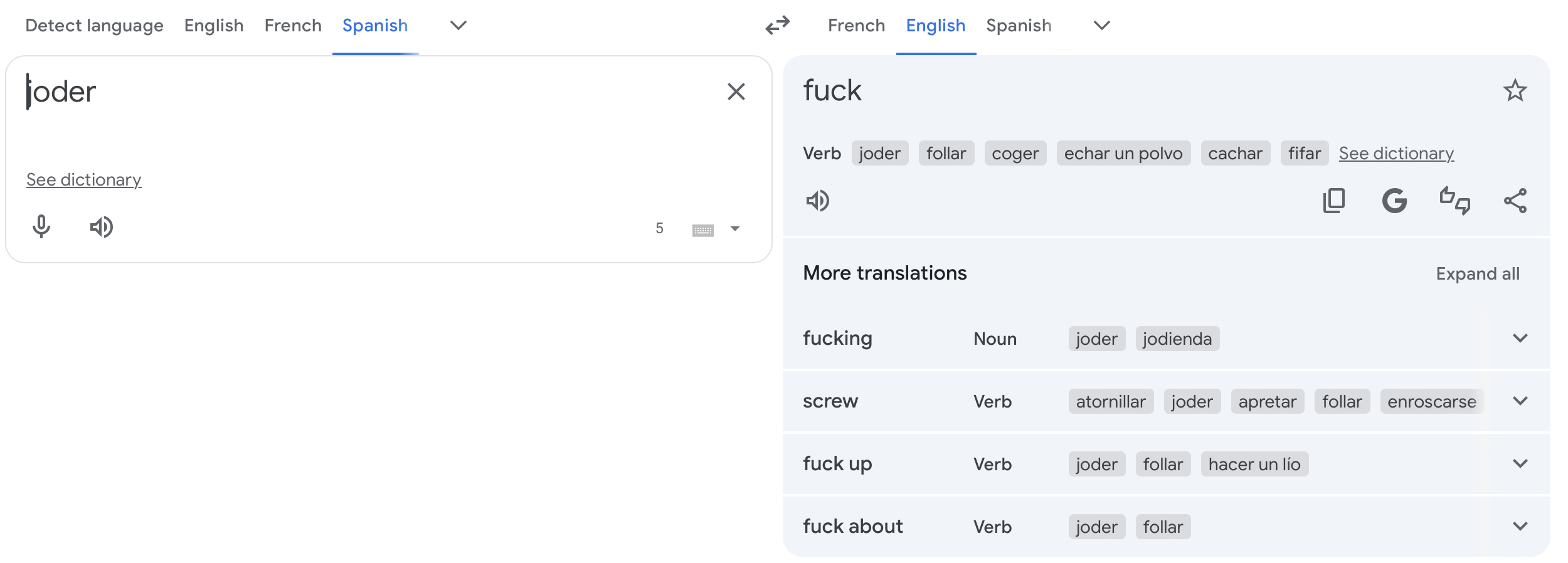
“Deslenguarte” (kind of “letting your tongue loose”) goes through a series of phrases that, on paper, should be highly offensive—“me cago en Dios” (I shit on God), “hostia” (“the host,” but it lands like holy shit or fuck), “coño” (also, fuck), “joder”(also fuck as well/damn)—but lands as casually as any fuck shit damn, merde or putain you might imagine. In France, I have heard many parents saying this to their children.

It’s not just about swearing. It’s about what happens when language breaks from meaning a bit & who gets to say what, where, and without consequence.
What’s a word or phrase that made no sense to you at first—and then suddenly did?
Or at least seemed like it should be highly offensive & nobody cared?

Disclaimer
WARNING: READ BEFORE USE
HIGH CULTURAL VOLATILITY. MISUSE MAY CAUSE OFFENSE, SOCIAL DAMAGE, OR TOTAL MISREADING OF INTENT.
- Regional Use Varies
In northern Spain (Asturias, Galicia), this functions as emotional release. Frequency ≠ hostility. - Do Not Export
Outside Spain, especially in Latin America, it may be heard as aggressive or deeply blasphemous. - Formal Use Prohibited
Avoid in work, institutions, or with people you don’t know well. Expect immediate discomfort & outcasting - Translation Risk
Direct translation intensifies impact. Local “punctuation” becomes explicit offense elsewhere. - Tone Is Everything
Meaning depends on delivery. Wrong tone = wrong message. - User Advisory
Observe before using. Timing matters more than grammar.
If unsure: default to “putain,” “goddamn,” or say nothing.