The Songs That Never Went Away & Never Should Have Been Made
Marujita Díaz, old songs, and what gets carried forward without question


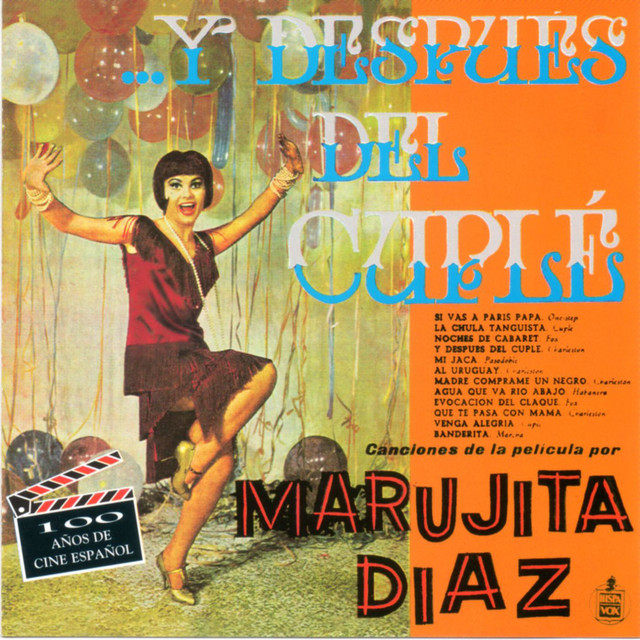
We were in Gijón, walking past one of those spots where the city drops these oversized cultural posters in random places—big images, a bit of text, an historical bit. Sometimes, they’re interesting.
He stopped.
“Joder… Marujita Díaz.”
Joder. Fuck. Luis says both. A lot.

Luis looked at her for a second, then said:
“Fuck. It’s sad. She was so popular in her day… but now she’s kind of a joke.”
The poster wasn’t treating her like a joke.
I’d never heard of her.
Which, as it turns out, is part of the story.
Why music?
I end up writing about music a lot.
Not really for the music itself, but for what it carries.
Songs stick around. They move. They get replayed without context.
And when you follow them, you start to see the culture that made them.
That’s interesting.
Starlet
She looked familiar: a 50s-era starlet, somewhere between ingénue and femme fatale.
Franco was in power then, and she fit the moment. Not rebellious. Not disruptive. A star of musical films and revue culture, working inside a system that favored spectacle, tradition, and a curated version of Spanish-ness.
Films, songs, scripts—all passed through filters. Political, moral, cultural. You could be popular, but within limits.
Older genres lingered, even as everything outside was changing. Spain presented back to itself—recognizable, repeatable. Stuck, in a way.
While films in France and Italy got more personal, more political, more edgy, Spain didn’t move that way.
If you were a performer like Marujita Díaz, you didn’t push against it.
& then you start to notice what made it through.
Listening to her music on random, I had to stop:
“…the fuck? Is she singing about the Klan—with castanets?”
To be fair, the lyrics are not flattering of the Klan, but still, how did this get made?
Madre, Compare un Negro — Marujita Diaz (1959)
Watching this video, I had a hard time pinning down what was most appalling. There was too much happening at once.
Upbeat, theatrical, meant to get a laugh.
The song goes… A kid hears jazz, likes the Charleston—1920s material—and wants a Black man to dance with. Or own. Or… something.
Yes—blackface.1
Yes—minstrel staging.2
Yeah.
And if that needs explaining, we’re already in different conversations.
Because it wasn’t a one-off.
Her catalog circles the same territory again:
“Ku Klux Klan.”
“La mulata Trinidad.”
“Llévame a Pekín.”
It’s all still here.
Remastered. Cleaned up. Reissued—unchanged.

Marujita
Born in Seville in 1932, María del Dulce Nombre Díaz Ruiz—Marujita Díaz—came out of the 1950s entertainment machine: revue theater, musical cinema, variety performance. Sanctioned art.
And she was popular. Film, television, records. Known everywhere in Spain.
But not outside. The songs, the style, the revue tradition—they didn’t travel well.
She was one of those artists who could sing the hell out of anything. An all-around entertainer. The full cabaret package—voice, movement, presence.
Big gestures.
Big voice.
That weird googly-eye thing she did at the start of her bits.
She delivered. Every time.
No matter the song.
The Asterisk
Some of these songs were already old—decades deep in revue and cuplé. Writers made them. Producers reused them. Labels recorded them.
And censors approved them.
Franco’s Spain didn’t just block things—it shaped them. This fit. It entertained. Didn’t challenge anything.
So it stayed.
And then there’s her.
Marujita is not fully responsible.
She’s not separate either.
She was huge. A performer who could carry anything.
And.
She sang material that now seems racist. And it would have read as racist then.
Not once. Not accidentally.
Both are true.
If you don’t name the asterisk, it disappears. Or worse, it becomes normal.
So despite all of that, she’s a skilled and entertaining performer. Small wonder she was popular.
This is her doing a medley on her show, Galas del sábado, in 1969.
I do love a medley:
Still Here
You can trace the path to modern availability:
film → song → compilation → reissue → streaming
Same material. Different decade. Cleaner audio, but no new context.
On YouTube, it looks archival—stacked albums, “Grandes Éxitos,” a preserved body of work.
On Spotify, tracks like “Ku Klux Klan,” “La mulata Trinidad,” “Llévame a Pekín” slide into autoplay.
They weren’t just products of their time.
They were already looking backward—echoing older, racist tropes.
And they outlived it.
Which is strange, given how much else disappears — or has been made to disappear.