From NYC to Paris - the World of French Rap
How French Hip Hop Became a Global Phenomenon, with a Little Help from Afrika Bambaataa

French rap was the first thing that made France feel familiar to me. Long before I could follow the lyrics, the beats made sense — like a parallel universe version of the music I grew up with in New York.
parellel universes
I’ve been diving deep into all kinds of French music lately, but before I got into Serge Gainsbourg, Jacques Dutronc and Dalida, it was the rap scene I was listening to. Growing up in the NYC suburbs during the 1980s, hip hop was massively influential.
The genre was full of unique artists and styles. I met De La Soul at a comic book store in Amityville once and went back every week for 6 months, just to see if they might be there again.
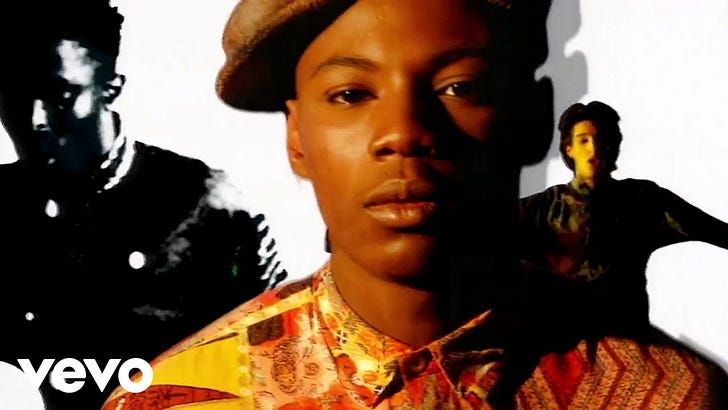
When I got to college, I discovered French rap, even though I couldn’t understand the lyrics. One of the first tracks I heard was MC Solaar’s 1990 Bouge de là (“Get out of the way,” more or less), built around a sample from Cymande's The Message.
The track has a smooth, clever and cool delivery, even if you don’t speak the language. And the video is beautifully 1990s.
Bouge de là - MC Solaar (1991)
MC Solaar was one of the first hip hop artists to have a truly massive hit in France. Blending social commentary with humor, it propelled him to international fame and marked a turning point for French hip hop, setting the stage for its global influence.
Solaar has released eight studio albums, and his 1991 debut, Qui sème le vent récolte le tempo, became one of France’s first major hip hop successes, selling over 400,000 copies. It’s now considered a classic. His follow-up, Prose Combat(1994), went on to sell more than 1 million copies worldwide
Rap & La Francophonie
France remains an important country for rap, but the massive breadth of Francophone hip hop extends far beyond its borders, with an incredible number of artists working in Canada, Belgium, and across Africa in places like Senegal, Ivory Coast, and the Democratic Republic of Congo.
Artists such as Didier Awadi and Daara J Family from Senegal, Youssoupha and Baloji from the DRC, and Didi B and Kajeem from Ivory Coast connect to and have reactied those traditions.
Rap has become a powerful tool for cultural expression and social commentary in many countries, following the ideals laid out by Afrika Bambaataa — the Bronx-born pioneer who pushed artists everywhere to express their own languages, histories, and identities rather than imitate American styles.
Bambaataa’s Influence
Hip hop started in France in the early 1980s, shortly after it began in the US. The movement began to take shape around 1982-1983, mostly in the suburbs of Paris. It was introduced through imported of American hip hop records, breakdancing, graffiti art, and early hip hop films like Wild Style (it’s a rap musical. Fantastic.) and Beat Street.
The French government supported hip hop with the Toubon Law, requiring 40% of music played on French radio to be in French. This wasn’t the law’s first intent, but it ensured significant airtime for popular genres like French-language rap.
The government legitimized hip hop with cultural funding, grants, and community programs that taught dance, music and even how to bomb graffiti, as hard as that might be to believe.
The first significant hip hop event in France was the New York City Rap Tour in 1982, bringing American artists like Afrika Bambaataa and the Soulsonic Force, Grandmixer DXT, and the Rock Steady Crew to perform in France.
Afrika Bambaataa was inspirational and had a global mindset that played a crucial role in expanding the genre's reach, including in France. Bambaata’s 1982 message was simple and clear, "If you're from France, rap in French; if you're from Germany, rap in German. Don’t just copy American styles—hip hop is about expressing your own culture and language."
Culture and the law
The rise of French rap was a collective effort.
After Bambaataa’s early influence, a mix of artist collaborations, government support, and radio language laws helped the genre shape its own identity, eventually making France the world’s second-largest hip hop market.
I first came to French rap through Bambaataa, too. When Public Enemy or De La Soul name-checked someone, my friends and I would hunt down the cassettes, trade them, make mix tapes, and play them until the tape warped.
The 1994 Toubon Law — which required French radio to play at least 40 percent French-language music — was meant to protect the culture from anglophone dominance, but it also gave French rap a major boost throughout the 1990s.
France even had its own hip hop TV show by 1984: H.I.P. H.O.P., hosted by DJ Sidney, the first Black TV presenter in the country and the host of the world’s first dedicated hip hop show. It only lasted a year, but its impact was enormous. By the late 1980s, artists like DJ Dee Nasty, Assassin, Suprême NTM, IAM, and MC Solaar had built the foundation of the French hip hop scene.
Hey! I love doing the research on these posts. Let me know if you want more! And let me know what were the firsts songs you heard in French. Or just any good music. I love to find more.
Related posts
 Keith Christiansen
 Keith Christiansen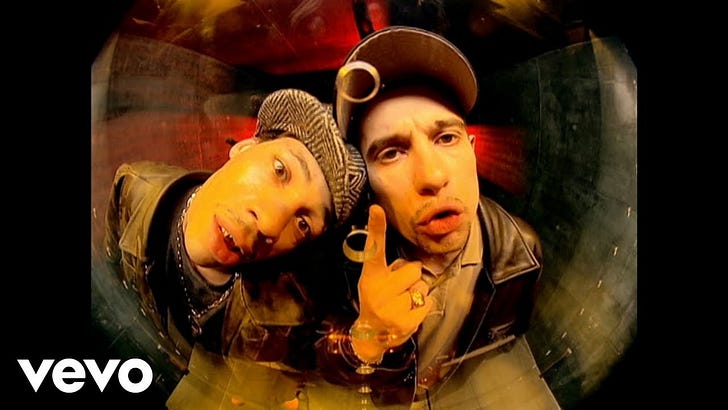
 Keith Christiansen