The Part Right After the Last Part You Said
How to lose your place without losing the conversation.
Marc had been holding forth for eleven minutes — I know because Théo, his son, was running a timer on his phone under the table, grinning at me the whole time — when he finally got to the point.
“I have to get angry.”
Bref: This one meanders a bit. A friend once told me the secret to learning Italian was getting angry. As a teacher, I can tell you: it isn’t. What works is a bit more like swimming, dancing, or maybe a figure skater getting up after a fall. Routines, (in)corrections, and what I do to remember what the hell I was trying to say before someone tries to fix my French.
“I have to get angry.”
We were at his birthday lunch, a long table outside a restaurant somewhere outside Venice, and Théo and I had been talking, quietly, about learning Italian. He’s living there and I was visiting, so any of the language I picked up was a bonus, but he’s got a lot more to navigate.
Marc does not enjoy quietly. He also has a habit of converting dialogues into monologues, the way some trees soak up sunlight before it reaches anything growing underneath. It’s just what they do.
“Alright, man,” I said, putting on my fiercest scowl. “Get angry. GrrrrRRrr! It’s your birthday.”
Théo made angry faces with me. I was happy about that.
“If I get angry enough,” in case we’d somehow missed the point, “I’ll learn Italian.”
“Presto! That is awesome,” I said. “Thank you so much for saying that.”
“I’m serious.”
“I know.”
Théo nearly choked on his wine.
As though fluency were an 80s training montage. Sweat harder. Get angrier. Italian surrenders. Ivan Drago goes down. Grazie.
Prego.
“You don’t understand,” he said. “That’s how I learn. That’s how I stay motivated.”
“If that was working, you’d be speaking Italian.”
Angry Dancing
I thought about that for weeks. Angry dancing. Furious swimming. I don’t know why those were the two that stuck, but once you start down that road you can’t really stop. Angry knitting. Furious parallel parking. Whatever.
There are books about swimming, books about dancing, and certainly books about languages. They’re useful. I’ve owned plenty. But at some point the instructions have to leave the page and get in your body.
I tell my students that language is about movement as well as thinking. We don’t learn it quite the way we learn most other things. It’s less like installing another piece of software than updating the operating system underneath. At first you’re consciously choosing every word. Eventually you’re just speaking. Or swimming. Or dancing.
To sound like Americans, I tell my students to speak through their nose. I think we have a very nose-forward dialect.
But…
Speaking is physical. It’s breath and timing and then maybe vocabulary and grammar. In French, there are so many free pronunciation corrections that I just bear it patently now.
If you gotta, go ahead.
Then I let them do their correction and get back to my point.
Anger might make you try harder for a while. It can’t make your body remember.
We don’t just learn languages; we learn how it feels to learn them. If every conversation feels like a test, or a battle, or something to be endured, that becomes part of the lesson too.
Maybe Marc would eventually find satisfaction in fighting his way through it. Some people do. But it still felt like he’d chosen to make himself one more obstacle. Learning another language is already difficult enough without deciding that your primary training partner is your own ego.
As good as I am at remembering embarrassing moments, embarrassment isn’t an efficient teaching strategy. Like most people, I’m much better at remembering the one awkward conversation than the twenty that went perfectly well.
Remembering the 20 helps. You can build on that.
Anyway, I told Marc I definitely wanted to be at whatever wedding he was dancing at next.
Showing Up
A few weeks after that lunch I tried to start a French conversation group in my town. I’d never quite found one that fit—most were aimed at students—so I thought I’d see if anyone else was looking for the same thing.
I’d timed it badly. A heat wave had just broken, everyone was wrung out, and the café where we’d planned to meet closed without warning the night before (Fermeture exceptionnelle). I moved the whole thing to a brewery across town, changed the time by an hour, and had the distinct feeling I’d just killed the idea before it had a chance to begin.
Nobody came.
But - I’d said I would be there, though, so I was.
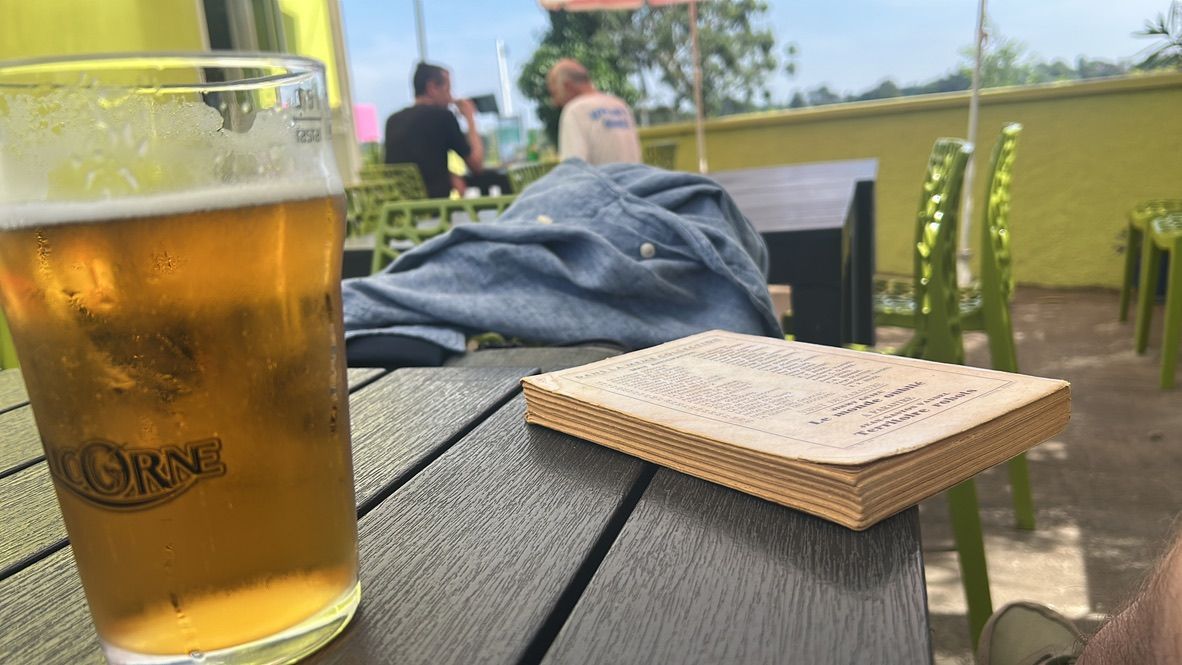
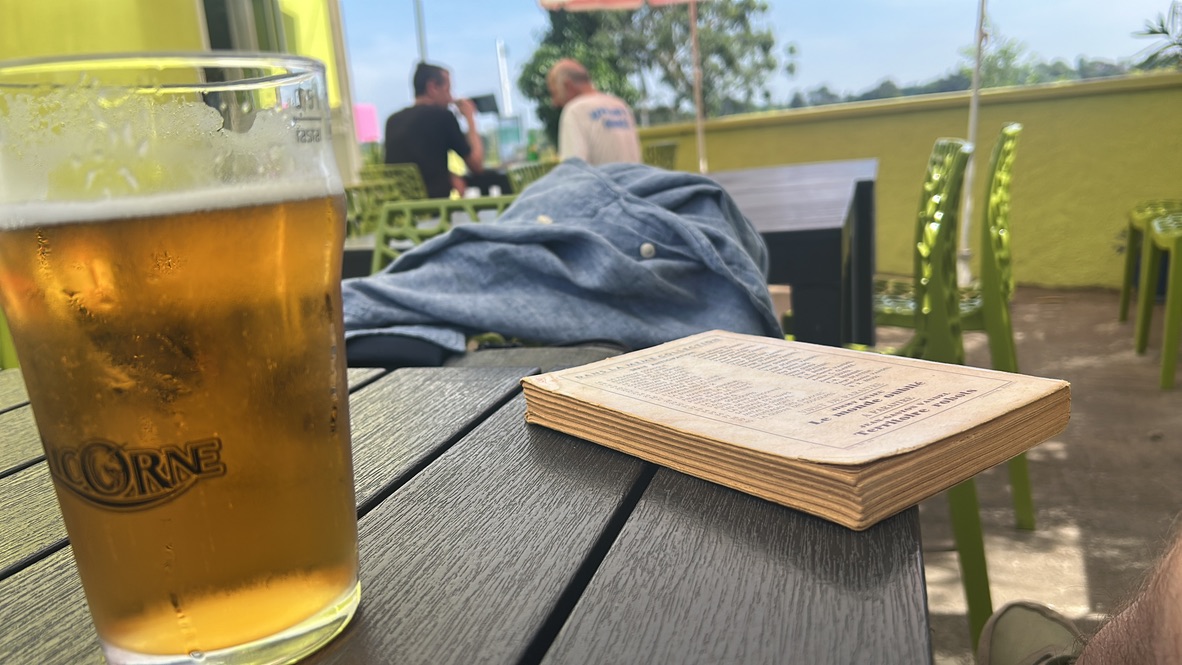
I ordered a drink, opened the French novel I’d brought, and read for the better part of two hours before walking home.
Somewhere around the second chapter, I found myself quietly hoping no one would show up and interrupt my reading.
That seemed useful.
The routine succeeded, kind of, even if the plan hadn’t.
The conversation group needs refinement—and fewer last-minute changes. I’ll give it another couple of tries this summer before trying again in the fall.
Invisible Routines
Later that same evening I spent a couple of hours with my friend Julien, and we ended up talking about routines. It’s become one of my favorite questions to ask people now and then—one I stole from my friend Bill, who’s been a bit of a mentor over the years.
People open up.
If they’ve been doing something for years, they’ve usually been thinking about it for years, too. They just haven’t had anyone ask.
Or maybe they haven’t realized they’ve been thinking about it.
“So Julien —what’s your routine like these days?” I asked.
He started talking about cycling. Or rather, about not cycling.
“I miss cycling. I really do. I keep thinking I’ll start again.”
“It’s a nice ride, actually... Beautiful trails near here…”
“Well, most of it.”
“The problem is getting back.”
“There’s that hill.”
“And then the other hill.”
Whenever I have parked outside of his house, I’ve been a bit worried that the car will start rolling down the hill, hit other cars, buildings, etc. In the right conditions, you can leave his house and coast for nearly a mile without touching the gas.
“The last bit I just push the bike.”
“It’s only... I don’t know... half a kilometer.”
It’s more.
“It’s fine.”
“...It’s just...”
“Okay. I haven’t been in months.”
“Okay. I never ride my bike.”
Then I asked him what he did do.
His whole posture changed. He leaned back. Slowed down. He talked about coffee. Reading. The same footpaths and checking in on plants. Checking in on friends. Cooking. The way he disappears into rabbit holes at eleven o’clock at night, almost every night. By the end he’d described a dozen routines, plus an elaborate sequence he goes through before he even gets in the shower.
My man folds his socks, like the package they came in.
I think he’d first answered the question he thought I was asking, like an export version of his own personality somehow. The bicycle had become the story he told himself about his routines. Everything else had disappeared through familiarity. As it should.
This happens all the time. We define ourselves relief, in a way, by the one habit we’ve lost instead of the dozen we’ve kept. But those quiet routines are the better place to begin. They’re already part of who we are—or at least what we do.
You can work with that, build on that.
We Teach What We Learned
I’ve seen this happen a thousand times. I’ve done it.
A student mispronounces a word. The teacher—in an earlier decade—jumps in. The pronunciation improves, maybe. The sentence, and whatever the person was actually trying to say, dies on the table.
The correction is usually right.
That’s not the point.
For a moment, the conversation stops being about communication and becomes about correctness. And that is a totally different lesson.
We teach the way we were taught. Not always, but it trends. We have methods from another time, defend them because they feel rigorous—or because they feel right—and ignore that we’re not teaching the same people, in the same place, or even for quite the same reasons.
Just because something worked for me doesn’t mean it’s the best way for someone else. —and if I taught in 2020 the way I learned in 1980, I’d have been fired for corporal punishment for at least a handful of reasons.
And they’d have been right to fire me.
Teaching has changed. Most of us have. What surprises me is how often everyday conversations haven’t.
It still impresses me how readily one adult will publicly correct another over something that barely matters to the conversation at hand.
For a moment, the conversation stops being about whatever the subject was and starts being about correctness. The more fluent person takes the floor from the person trying to get a point across. The power shifts, even when everyone involved is trying to be kind, even when nobody means it that way.
The whole dynamic is changes and dialogue because monologue. Or at least, it became irrelevant to whatever we were saying before.
Most conversational corrections teach two lessons. Grammar, pronunciation, whatever. Then the emotional register. Sometimes the emotional lesson is I’m getting better. Sometimes it’s I will never talk to this person again if I can possibly avoid it. Grammar matters. So does the second lesson.
Most times, people will not remember exactly what you said even in your first language. But they will remember how you made them feel.
Try not to surround yourself with people who are stomping on your sprouts.
Après tout cela
I’ve stood through conversations about the correct uses of dedans, depuis, après, and half a dozen other tiny words when I first met my neighbor.
I’d somehow gotten cornered on the lawn during a barbecue. He was gesturing at me with a grilled sausage wrapped in a crêpe—perfectly normal thing in this part of France.
He was also a close talker.
With his light brown shirt unbuttoned to the waist, he resembled his lunch a bit. I have no idea what his actual name is and I have seen him dozens of times since.
Sausage Guy.
He waved the sausage at me.
“So... how long have you been in France?”
He never got his answer. Mr. Sausage was gonna help me.
Le voisin (Monsieur Saucisse): Depuis combien de temps es-tu en France ? (How long have you been in France?)
Moi: Trois ans, je crois. (Three years, I think.)
Lui: Ah, non. Depuis trois ans. Tu vois, depuis, pendant, il y a... ce n’est pas la même chose. Laisse-moi t’expliquer... (Ah, no. Depuis three years. You see, depuis, pendant, il y a... they’re not the same thing. Let me explain...)
This went on for a while. I made short work of my very tiny bottle of beer.
“Nice meeting you,” I said. “I’m going to grab a beer. I’ll be right back.”
I wasn’t.
I might have learned something about those words.
But I definitely learned that I didn’t want to have another conversation with him. As I searched for another teeny beer bottle (20cl! - they do stay cold), I saw his open-mouthed chewing and then quickly turned my attention to anything else. I chatted with another neighbor and we had a lovely exchange, even as I was doing abusive things to French.
My own rule now, for what it’s worth, is simple: if correcting someone means interrupting the thought, I let it go. If it’s a pattern, I’ll mention it once they’ve finished, if they want me to. If the meaning is clear, I’d rather keep the conversation going than fix a verb ending.
The goal isn’t perfect French. It’s better French.
More importantly, it means coming back another conversation tomorrow.
But I’ll probably never speak to Mr. Sausage again if I can possibly help it.
Keeping My Place
I ended up next to Camille at one of the networking dinners I drift into every now and then.
Camille corrects my French. A lot. The way some people can’t stop tidying a room, or pulling at a loose thread.
Somewhere along the line I developed a habit of keeping interrupted thoughts on my fingers. Whenever someone cuts me off, I quietly touch my thumb to a finger and leave the thought there until I get the floor back. It’s less about remembering the sentence than remembering where to begin again.
I don’t even remember when I started doing it.
I’m pretty sure it came from years in classrooms. If you can’t lose your train of thought, find it again, and keep teaching after thirty thirteen-year-olds interrupt you every forty-five seconds, you’re in the wrong profession.
I’ve noticed I usually have about four interruptions in me before I stop trying, for whatever reason. I should push it a little, bit sometimes, I have just lost my thought entirely, or maybe I just don’t wanna keep talking to this one.
Somewhere along the line I developed a habit.
Someone interrupts me. I quietly touch my thumb to a finger. Find something in the room. Hold the thought there. Wait until it’s my turn again.
It isn’t about remembering the sentence.
It’s about remembering where to begin again.
It probably comes from years in classrooms. If you can’t lose your train of thought, find it again, and keep teaching after thirty thirteen-year-olds interrupt you every forty-five seconds, you’re in the wrong profession.
It goes something like this.
“How long have you been in France?”
I start answering.
Someone interrupts to explain the difference between depuis and pendant.
One.
Thumb to finger.
Salt shaker next to ketchup.
Wait.
I look back at the person who interrupted me, let them finish, find the salt shaker & ketchup, remember I was answering a question about how long I’d been in France, and pick the sentence back up.
Thirty seconds later...
“So where did you live before?”
I get halfway through Brooklyn.
“Actually, you should say à Brooklyn, not dans Brooklyn...”
Two.
Thumb to finger.
That crack in the plaster that looks like Corsica.
Wait.
Find the crack: Corsica. Find the sentence. Keep going.
By the third interruption i’m usually looking for a person: Mullet Guy, Unironic Mustache. to remember and to plan an escape from this conversations.
By the fourth, hats, odd furniture.
After that...
I tend to stop trying.
I’ve noticed I have about four interruptions in me before I kind of leave: someone else can have the conversation. Maybe I should push that some. Maybe it’s just a useful way of identifying the people I don’t particularly want to talk to.
How many interruptions do you have in you before you stop trying? And if you have your own version of a fourth finger—a way of finding your place again—I’d love to hear about it.
Recovery
I love how figure skaters recovery, but it’s hard not to focus on the flaw when there is so much near-perfection. But people do.
They fall. They get up. They keep skating & come up smiling, the show must go one, etc.. If you looked away at the right second, you might not notice. But they recover — the routine is more than the mistake.
[many of my conversations have felt like that]
I tell my students that learning a language more like learning to move. It’s thought and memory, yes. But it’s also breath, timing, rhythm — conversations happens in real time, and eventually the language has to get into your body. Language is less like installing another piece of software and more like updating the operating system.
We don’t learn languages unbundled. But if we’re aware of it, we might be able to untether it a little.
The recovery is the skill. Nobody puts that part in the montage. After that rough workout, Rocky probably needed to ice himself and have some snacks.
Marc wanted anger because he thought intensity was his engine, or at least he was trying to convince me it was. What a weird thing to say - was it to project toughness? Was it a sideways way of saying he was content in his life right now? I’m happy, that’s why I can’t speak Italian?
Anyway…
I think recovery is the hidden skill there. Anger might get you started, but recovery and grace is what gets you back tomorrow — and back the day after that, which is the part that counts.
Besides. What would you even sound like, learning angry Italian?