Assuming France Agrees
There’s a difference between living somewhere and making yourself legible to the place you live.
Why we’re still in France, why I’ve been quiet, and why the answer is probably not coming quickly
Bref:
France frustrates me regularly. We keep reassessing. We keep staying. This is about bureaucracy, heat, language, mythology, and why France still somehow ends up at the top of the list.
Assuming France will have us.
[Editor’s Note: This piece is a bit of a grab bag.
Partly because I’ve been buried in a book manuscript. Partly because I’ve spent an unreasonable amount of time explaining my professional existence to French bureaucracy. Partly because it has been hot enough to interfere with higher reasoning, including editing.
Mostly because the Brain Hamster that powers this newsletter eventually starts screaming if I don’t publish something.
So this is less a finished essay than a dispatch from the middle of things.
Also, welcome to the many new subscribers who have joined recently. I’d genuinely love to hear from you. One of the nicest surprises of writing this newsletter has been the folks who show up in the comments.]
Learning Visiblity
I haven’t been writing here very much lately.
Partly because of the book. The manuscript is somewhere around eighty thousand words now, which sounds more impressive than it is. If you’ve been reading this newsletter for any length of time, you’ve already seen the problem. If I can disappear down three side roads in a thousand words, imagine what happens when nobody is enforcing a speed limit. Some days it feels like a memoir. Other days it feels like an archaeological dig. Either way, it has been consuming most of the writing energy I have.
Then there’s the visa.
Or more accurately, the next visa.
The current process has involved projections, business plans, financial statements, explanatory letters, and a surprising amount of time spent trying to describe my professional life in a way that makes sense to someone who has never met me. The work itself is not particularly complicated. I’ve been doing versions of it for years: writing, editing, research, communications, consulting, teaching. It makes sense when viewed across a lifetime. It becomes considerably harder to explain when compressed into a handful of administrative categories.
In my mind, I call the prefecture the Tomb of the Unknown Result.
Not because the people are bad. Most of the people I’ve dealt with have been professional, and some have been genuinely helpful. But there is something unsettling about preparing documents for months for an audience you will never meet, answering questions you can only partially anticipate, then sending everything into the administrative void and waiting to discover whether you’ve explained yourself well enough.
The invisible bureaucrat becomes a character. Not a villain, exactly. More like an editor who keeps sending notes from an undisclosed location.
What I’ve slowly realized, though, is that the real challenge isn’t bureaucracy.
It’s translation.
There is a difference between existing somewhere and being legible there.
France wants to know who you are. Not personally. Institutionally. What do you do? Where do you fit? How should the system understand you? How should it classify you?
Those questions sound simple until you try answering them.
Especially if your life has not followed a straight line. Especially if you’ve spent years doing work that crosses categories. Especially if you’ve reached the point where your professional identity can legitimately be several things at once.
That’s not difficulty.
It’s the kind of complication you encounter when translating something from one language into another and discovering that the exact word doesn’t exist. The meaning is there. The idea is there. The context is there. But something gets lost in the transfer.
That’s what this process often feels like.
Translation of work.
Translation of identity.
Translation of a life that made perfect sense in one context and now has to be explained in another.
And sometimes that same feeling appears outside the paperwork.
Sometimes it’s a conversation. Sometimes it’s trying to explain an idea. Sometimes it’s ordering a beer and having someone interrupt halfway through your sentence to inform you, with genuine conviction, that they understood absolutely nothing you just said.
When the obstacle stops being difficult and starts becoming absurd, the honest response is to want to leave. Not because it’s hard.
Because it’s stupid.
And yet the longer we’re here, the more I suspect that this process is not really about paperwork at all.
It’s about becoming visible.
Not visible as a tourist. Not visible as a visitor. Visible enough that your life begins to make sense within the place you’ve chosen.
That takes longer than I expected. Longer than learning where to shop. Longer than learning how taxes work. Longer than learning the language itself.
Maybe that’s why I’ve been thinking about it so much lately.
Not because we’re trying to decide whether France works.
Because we’re trying to decide whether we do.
The Weather Has New Names
Then there’s the canicule.
Which translates into Severe High Temperature Warning. But not quite.
It’s been sitting over western Europe for weeks now, drawing hot air straight up from North Africa and pouring incredible heat into unfamiliar parts of France. By two o’clock the light has that effect that they use in movies to show that things are “foreign” like the Mexico filter, even if Mexico looks nothing like that.
But France does at 2pm. Blaring.
The stone building we’re staying in does its best, slowly bleeding out the previous day’s heat through the night, but by late afternoon even the walls seem tired.
The mornings are better.
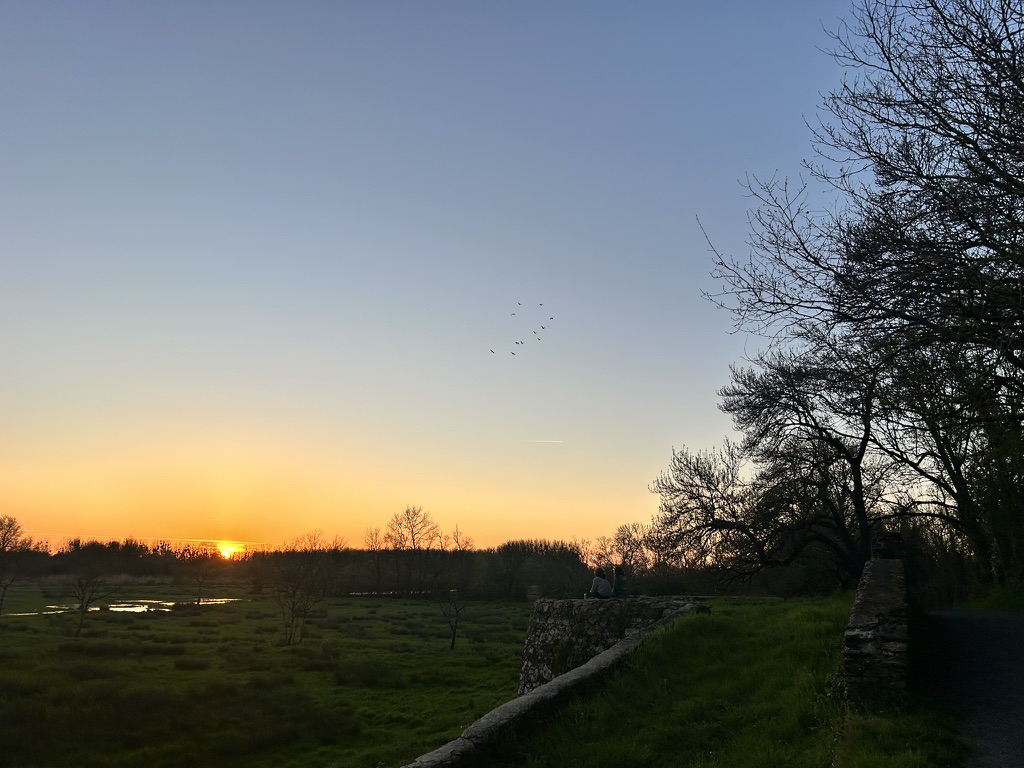
I wake around five or six most days. The windows are open. The air is cool again. Somewhere down the hill a bird is already conducting business. The coffee goes on. For an hour or two, before the heat returns, everything feels possible.
Those have become my thinking hours.
The book. The visa. Money. Housing. France. The future. Every major decision we’ve made seems to quietly line up for review before the day gets hot enough to interfere.
Maybe that’s why the weather has been on my mind.
One of the stranger things about the last twenty years is that we’ve developed an entirely new vocabulary for it.
Heat domes.
Atmospheric rivers.
Bomb cyclones.
Polar vortices.
Once-in-a-century floods that seem to arrive every few years.
In French, it’s dômes de chaleur, rivières atmosphériques, cyclones explosifs, and canicules.
That last one doesn’t really translate.
“Heat wave” is close, but not quite. Canicule, it seems, comes from the Latin for “little dog,” a reference to Sirius, the Dog Star, whose appearance was once blamed for the worst heat of summer—like 1,000 years ago.
The word carries more weight than “heat wave.” Government warnings. Closed shutters. Check on elderly neighbors. Everyone knows exactly what you mean when you say it.
Canicule: it’s hot, and we can all agree that this has stopped being normal.
Language quickly adapts when reality changes.
Nobody was talking about atmospheric rivers when I was a kid.
Wet-bulb temperatures?
Nobody was debating whether their apartment would remain habitable during a prolonged heat event.
Now these things arrive with their own terminology, their own graphics, their own official explanations. Entire sections of the weather report would have sounded like science fiction twenty years ago.
The weather changed.
The language changed.
The question I’ve been wrestling with lately is whether people work the same way.
How much of building a life somewhere is simply learning a new vocabulary and kind of grounding it in your own experience? In your body?
Not the words.
The meanings.
Not a Francophile
I should probably clarify something.
I’m not a Francophile.
At least not in the way the word is usually used. I don’t believe France has discovered the secret to civilization. I don’t think every French idea is automatically superior because it is French. I don’t get misty-eyed over bureaucracy, cigarette smoke, or the existential significance of yogurt.
I like France. Quite a bit, actually.
But there’s a difference between liking a place and worshipping it.
I’ve always found it interesting that we have words for people who become enamored with other countries. Francophile. Anglophile. Russophile. Sinophile. There isn’t really a common equivalent for someone who likes America. “Americophile” technically exists, but almost nobody says it.
Maybe that’s because America became so culturally dominant that admiration stopped needing a special category. Or maybe it’s because liking America was long treated as the default setting.
Either way, I never felt the need to trade one mythology for another.
The truth is more complicated.
I still love a lot about where I came from.
The energy. The creativity. The willingness to try things. The strange American belief that you can reinvent yourself at forty-five and there will be people standing on the sidelines yelling encouragement.
Woo!
I genuinely love that about us.
But loving a place and living there are different things.
I’ve learned that appreciation and compatibility are not the same thing. You can love something, admire something, even feel grateful for what it gave you, and still recognize that your life works better without it.
That applies to places. Jobs. Relationships. Entire versions of yourself.
What surprised me after leaving wasn’t a political revelation or some sudden clarity about America.
It was how long it took certain feelings to disappear.
The constant vigilance.
The ambient stress.
The strange assumption that ordinary problems could suddenly become expensive problems.
The feeling that there was always something lurking just beyond the edge of your attention that would eventually require money, paperwork, conflict, or all three.
When I lived in New York, I thought that was normal.
Fish don’t notice water.
Only after I left did I realize how much of my daily life had been organized around managing it.
The closest comparison I’ve found is tinnitus.
Not because it goes away.
Because one day you realize it’s quieter than it used to be.
Then quieter still.
And after a while you begin to remember that there was a silence underneath it all along.
Or maybe you’re only remembering the idea of silence. I’m not entirely sure.
I don’t think I’ll ever see the America of my childhood again. Then again, I’m not sure I ever saw it particularly clearly the first time. Memory edits. Nostalgia edits even more aggressively.
Either way, I don’t expect many of the conditions that pushed us to leave to change in my lifetime.
Leaving didn’t solve every problem.
But it solved some.
A few of them turned out to be much larger than I understood at the time.
I don’t think I could go back now, even if I wanted to.
And I don’t really want to.
I still have affection for America. I probably always will.
Affection and compatibility are not the same thing.
The country increasingly reminds me of that relative every family seems to have. Funny. Generous. Capable of moments of real brilliance. Also exhausting. Occasionally frightening. Surrounded by problems everyone can see but nobody seems able to address.
You love them.
You wish them well.
You hope things improve.
You just can’t live with them anymore.
What’s Working?
Maybe I’ve been thinking about this because of the heat.
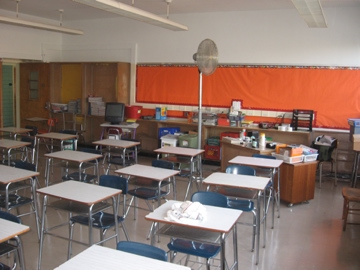
I spent years teaching in New York City public schools, and by the time June arrived, everyone was running on fumes. Sometimes September was worse. Occasionally October got involved. Air conditioning seemed to depend on a combination of luck, building age, and local political influence. Some classrooms had it. Most didn’t.
You’d spend seven hours standing in front of thirty kids while your shirt slowly attached itself to your body. By September I wore darker colors because they hid sweat better. I developed a weird technique of cooling my breathing through my mouth like a dog. It sounds ridiculous until you’ve spent an afternoon trying to teach a room full of twelve-year-olds while the temperature creeps steadily upward and everyone’s patience evaporates at roughly the same rate.
Heat changes behavior.
Everyone becomes a little less generous. A little less patient. Small annoyances become major grievances. I am pretty sure more people get shot in the US when it’s hot.
A surprising amount of civilization turns out to be temperature-dependent.
Around the same time, I banned red pens.
Partly because I’d read something about the psychology of editing, but mostly because middle school students will turn criticism into a blood sport if you let them. We switched to green pens and, more importantly, we changed the order of operations.
Before anything else, we asked: What’s working here? What is this person actually trying to do?
Only after that did we ask what needed fixing.
It sounds like a minor adjustment. It isn’t.
If your first instinct is always error detection, eventually error becomes the only thing you can see.
I’ve been thinking about that a lot lately.
Partly because the internet rewards it. Partly because politics rewards it. Mostly because moving to another country gives you endless opportunities to practice it.
France makes this remarkably easy.
There is always something to complain about. The paperwork. The bureaucracy. The occasional cultural performance. The fact that I can successfully navigate three-quarters of a conversation only to discover that the remaining quarter has apparently invalidated the entire exchange.
And most of the complaints are at least partially true.
But if I stop there, I’m doing exactly what my students did with the red pens.
I’m circling mistakes.
I’m not reading the paper.
Because underneath all of the frustrations is a question I’ve been wrestling with for the better part of a year.
What exactly is still working here?
Not perfectly. Not efficiently. Not always successfully.
But what remains?
I notice it in small things more than large ones. Children walking home from school alone. Markets that still function as markets rather than tourist attractions. Libraries. Lunch that is still treated as lunch. A public conversation that can be exhausting but at least continues to exist. The lingering assumption that some things belong to everyone and that society is more than a collection of private transactions.
Not all of it works.
Some of it works badly.
Some of it survives largely because nobody killed it.
But there is a kind of resistance built into the place. Not revolutionary resistance. Something slower.
The resistance of a society that occasionally answers the question, “Why are we still doing it this way?” with “Because we decided it was worth keeping. But we decided.”
But just as often, it’s a society that demands that you don’t fuck with their morning routine, their holidays, their expectations..
As someone trying to build a life here, I find myself appreciating it more than I expected. But I have to remind myself to look for it.
What France Protects
The more time I spend here, the less interested I become in arguments about whether France is better than America.
Better at what?
Every place is carrying its own collection of problems. France certainly is. I could make a list. Housing. Bureaucracy. Economic stagnation. Political dysfunction. Labor rigidity. A tendency to mistake complexity for sophistication. Some days I could probably make the list with enthusiasm.
But the existence of problems isn’t especially interesting. Every country has those.
What interests me more is what a society chooses to protect when it has the opportunity.
The thing I keep running into here, sometimes intentionally and sometimes by accident, is an unusual emphasis on daily life. Lunch. Markets. Libraries. Vacation time. Public transportation. Walkable town centers. The assumption that an ordinary Tuesday should contain something other than work.
None of those things are uniquely French. None exist perfectly. Most are under pressure. Some are actively being dismantled. Others survive largely because generations of stubborn people have refused to let them disappear.
But they matter.
And increasingly, they strike me as political in a way that has very little to do with left and right. They’re arguments about what life is for. About whether efficiency should always win. About whether every human activity needs to become a market. About whether a society exists only to produce economic outcomes, or whether it has some responsibility to produce livable days.
France doesn’t answer those questions perfectly. Sometimes it doesn’t answer them well at all.
But it keeps asking them.
That feels significant. Especially now.
Which brings me back to the mornings.
The cool air before the heat arrives. The coffee. The bird conducting business somewhere down the hill. The hour or two before the canicule returns and everything becomes survival again.
That’s where most of the real thinking happens. The book. The visa. The money. The future. The question of whether we’re still in the right place.
The answer keeps coming back the same way.
Not because France has stopped frustrating me. Not because the paperwork has gotten simpler or my French has stopped alarming people. Not because we’ve talked ourselves into believing this is perfect.
But because we’ve done the honest accounting, and the life we’re trying to build still makes sense here. More sense, after everything, than the alternatives.
That isn’t a declaration. It’s a status update.
The next review will happen soon enough.
France remains the answer.
At least for now.
Assuming France agrees.
Postscript: It turns out France already has a song about a hamster.
Monsieur Fred Hamster — Chantal Goya (1983)
Not the version I imagined. Not a tragic hamster smoking Gauloises outside a train station and contemplating bureaucracy. This one tap dances, signs a Hollywood contract, becomes a choreographer, and at one point is described as dancing comme un dieu — like a god.
This video was also clearly created before children’s television was fully weaponized into a perpetual marketing machine.
The Brain Hamster seemed pleased by this discovery and insisted I share it.