This is Not America
Memory, myth, and what burns after the fireworks
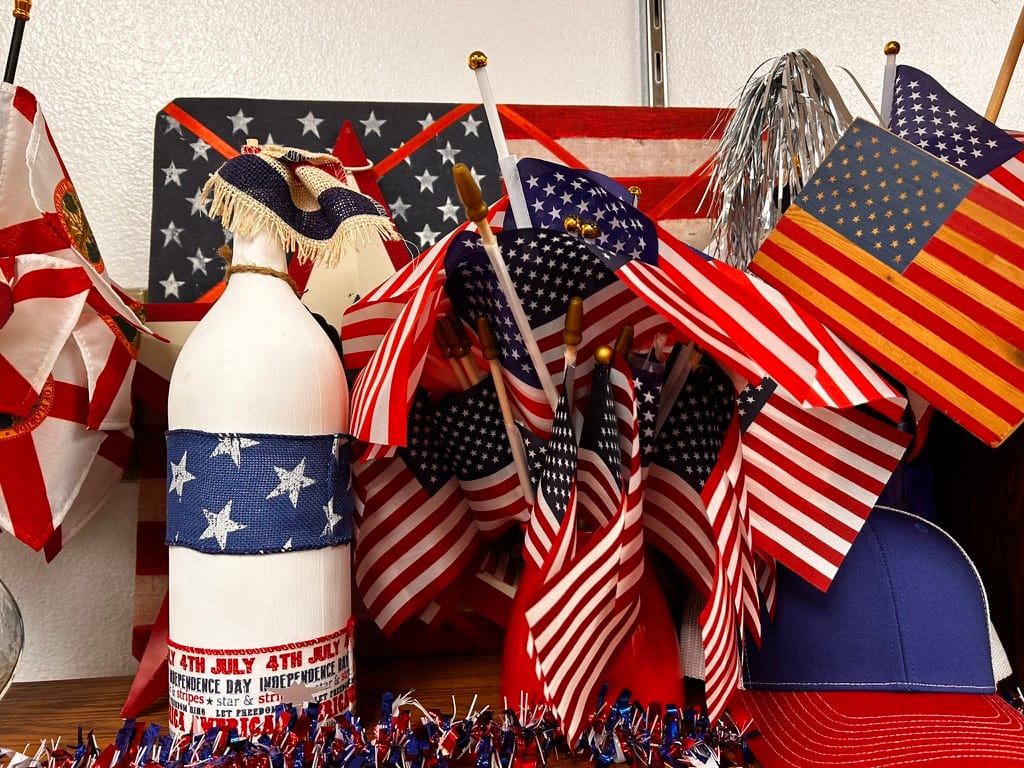
Every Fourth of July, I feel the tug: part of me wants to say something nice about America. This year, I wrote instead. Not to mourn or glorify, but to sit in the complicated space between memory and what I think I know these days. This piece isn’t a eulogy. It’s an attempt to name missing pieces, what’s always been broken for some, and what still, miraculously, survives. It's a conversation with Langston Hughes, with kids I used to teach, with the voice in my head that still believes in something better, even now.
TL;DR
I wrote a poem.
It’s the 4th of July, or Independence Day in the US.
“Let America be the dream the dreamers dreamed—
Let it be that great strong land of love.”
—Langston Hughes, Let America Be America Again (1936)
This Is Not America
(but maybe it always was)
I’m already telling myself don’t write like this.
[ed note: feels… tired. Overdone.]
It’s the Fourth of July in France.
another quiet afternoon.
No fireworks.
No flags.
No barbecues.
No parades.
No WHOOO!.
The caricature of America floats around cafés—
cowboys, big skies, rock ’n’ roll
It’s a bit charming.
Idealized
But easier to love.
The voice in my head wants to say something nice.
Offer qualifiers.
Explain America.
Because we don’t understand
[ed note: mention the national parks? jazz? strangers helping each other after 9/11?
also: most Americans are lovely people.]
There was the blackout in 2003—
corporate negligence and deregulation killed the power grid.
No, really.
And…
Times Square went dark.
Trains stopped. Elevators froze.
55 million people, stranded in summer heat.
And still—
people directed traffic.
Handed out water.
Shared food.
Played concerts to pass the time.
I remember standing at 42nd and 7th Ave,
Times Square gone totally dark,
eating melting ice cream someone sold at a discount
from a dark deli.
Laughing with people I didn’t know.
The lights failed.
people didn’t.
This Is Not America
(but my voice is still there)
That voice in my head is loud.
It is mine.
I think.
(It is American.)
It’s the loud American voice in a quiet French bar,
bringing up bad food or
Great America Stuff
but nobody asked.
I was trained to temper my criticism
of America
I don’t even know
by whom.
Somewhere along the way,
I learned:
when you say the U.S. is failing,
Any of it,
you follow up with a flag,
a joke,
or a hopeful comment.
Or a smile
Or say how nice American people are.
This Is Not America
(not a metaphor)
America isn’t a metaphor anymore.
I think it used to be.
It’s not a dream.
It’s not an ideal.
That’s why we’re all a bit surprised.
This Is Not America
(but we called it safety)
At my school, every day,
children walked through metal detectors—
and we called it safety.
Then they climbed four tall flights of stairs,
to practice active shooter drills before lunch.
They recited a pledge
without knowing what “allegiance” even meant—
a ritual few countries require.
Most democracies don’t demand
daily loyalty oaths to a flag.
And in the same country,
police kill citizens,
Who looked like my students
while the news debates
whether the citizen deserved it.

This Is Not America
(and yet)
I taught for twenty years in public schools.
The kind they write about but never visit.
South Bronx. Brownsville. Brooklyn—before the brunch menus.
The kids were brilliant.
Sometimes.
Exhausted.
Sometimes.
Funny.
Sometimes.
Yet learning how to survive a system built to erase them.
And still—poetry.
Not just the violence—
the paperwork, the hunger,
the bone-deep stress that ages you before thirteen.
I didn’t save anyone.
I just showed up.
Tried to stay.
Tried to keep the beat going.
Because even in a place not built for miracles,—
they happened anyway.
This Is Not America
(and not nostalgia)
This isn’t nostalgia.
It’s about what we call it
and who gets to claim it.
I used to talk about “America” as a concept.
I mean, to children, but still…
Even when it failed you,
you could still hold the idea out there—
freedom, reinvention, all that.
But when freedom and unfreedom
speak the same language,
When the world is watching and they don’t care
when the symbols serve violence,
when the flag becomes body armor—
for the wrong side—
it stops being metaphor.
It becomes function.
And function has intent.
If it’s not built to protect you,
you learn that fast.
Some already know knew.
…and yet loved it?
This was is home.
It’s not what America says.
It’s what it does.
So yeah, I left.
[ed note: still think about it. You see more from a distance.]
[ed note: maybe optimism is armor. Maybe it’s a way to begin again.]
This Is Not America
(but it is)
In other places, “America” is not just America.
In Peru, they say:
“Roba, pero hace obras.”
He steals, but at least he builds.
But this one?
Roba, y ni obras hace.
He steals—and builds nothing.
In France, fireworks are called feu d’artifice.
Artificial fire.
A trick of light.
Meant to dazzle, then disappear.
They’re not built to last—
just to distract.
But what’s happening now isn’t a show.
the distractions are not symbolic.
And it keeps burning
long after the crowd goes home.
This Is Not America
(but it is.)
This isn’t the America of my memory—
though for some, it is.
It’s a continuation of a history.
And there is history.
And yet—
despite the brutality,
the erasure,
the forgetting—
beautiful things happened.
Still happen.
Kids still wrote poems.
Strangers still helped each other.
The people who were never meant to survive
survived.
And built for others.
There’s work beyond the spectacle—
even as the spectacle burns.
There’s more than flags,
more than slogans,
more than nostalgia loops.
More than the old myth.
More than even this collapse.
[ed note: does this metaphor work? Is it a metaphor?]
The fireworks stop.
The show ends.
And maybe then,
we can go home.
This is not America.
But it is.
k
Musical accompaniment
C’est peut être pas l’Amérique Jean Claude Pascal (1981)
“C’est peut-être pas l’Amérique” translates to “It may not be America.” Released in 1981, it was Luxembourg’s entry in the Eurovision Song Contest. Not quite a protest, but counters the myth of America while affirming something more local, grounded, and tender. It’s a song about dignity without spectacle, affection without illusion, the subtle joyful humility of being… Luxembourgian?
And yet, it was performed at Eurovision: a glitter-drenched pageant of national branding. So that tracks.