Foie Gras Faux Pas: A French Holiday Staple
Ancient & Modern: the Rich History and Controversy food
Foie gras is divisive - and reasonably. I’d gather that a good number of people would read the title, know it’s about foie gras and already have an opinion one way or the other, but it’s mostly negative.
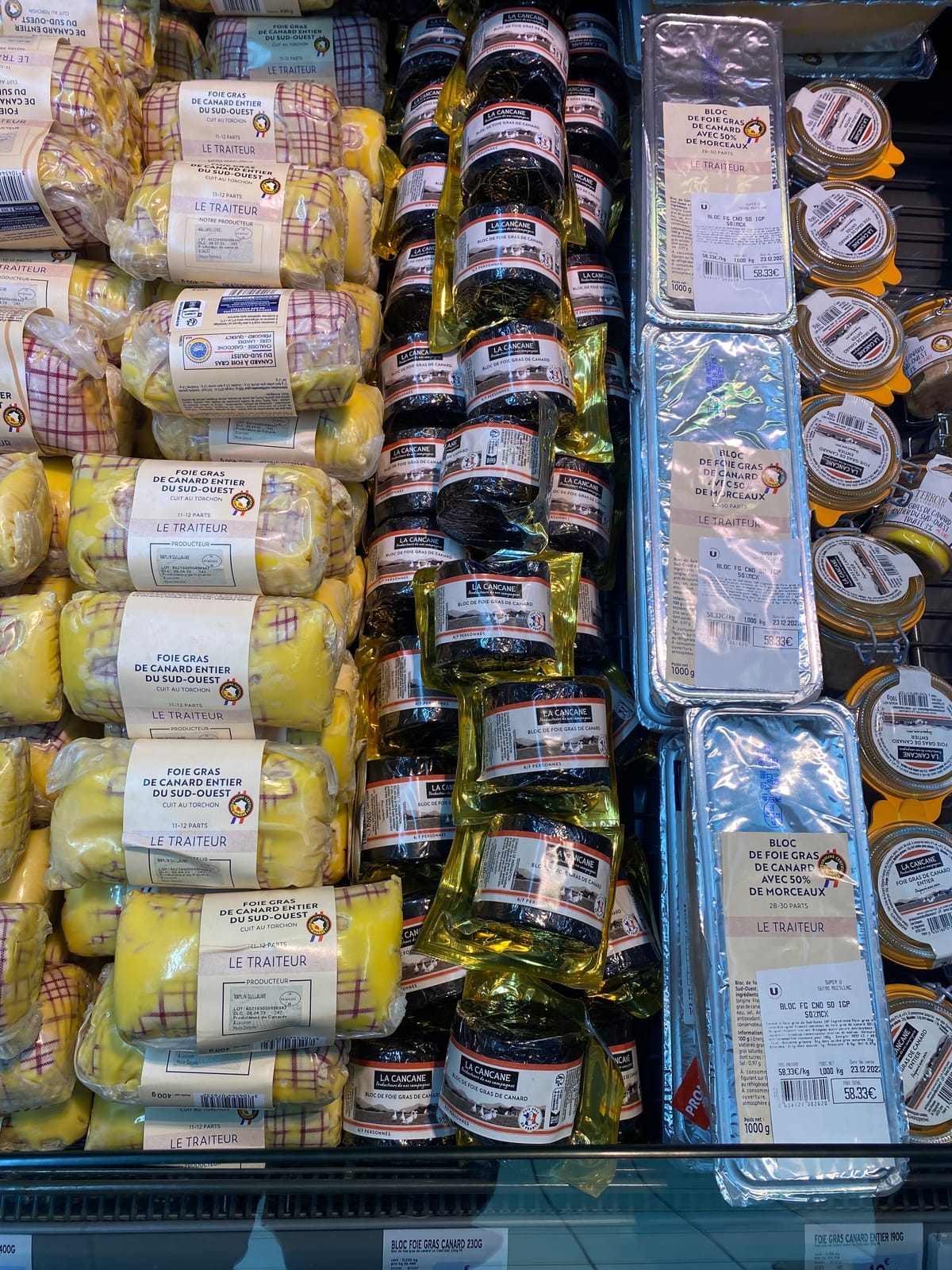
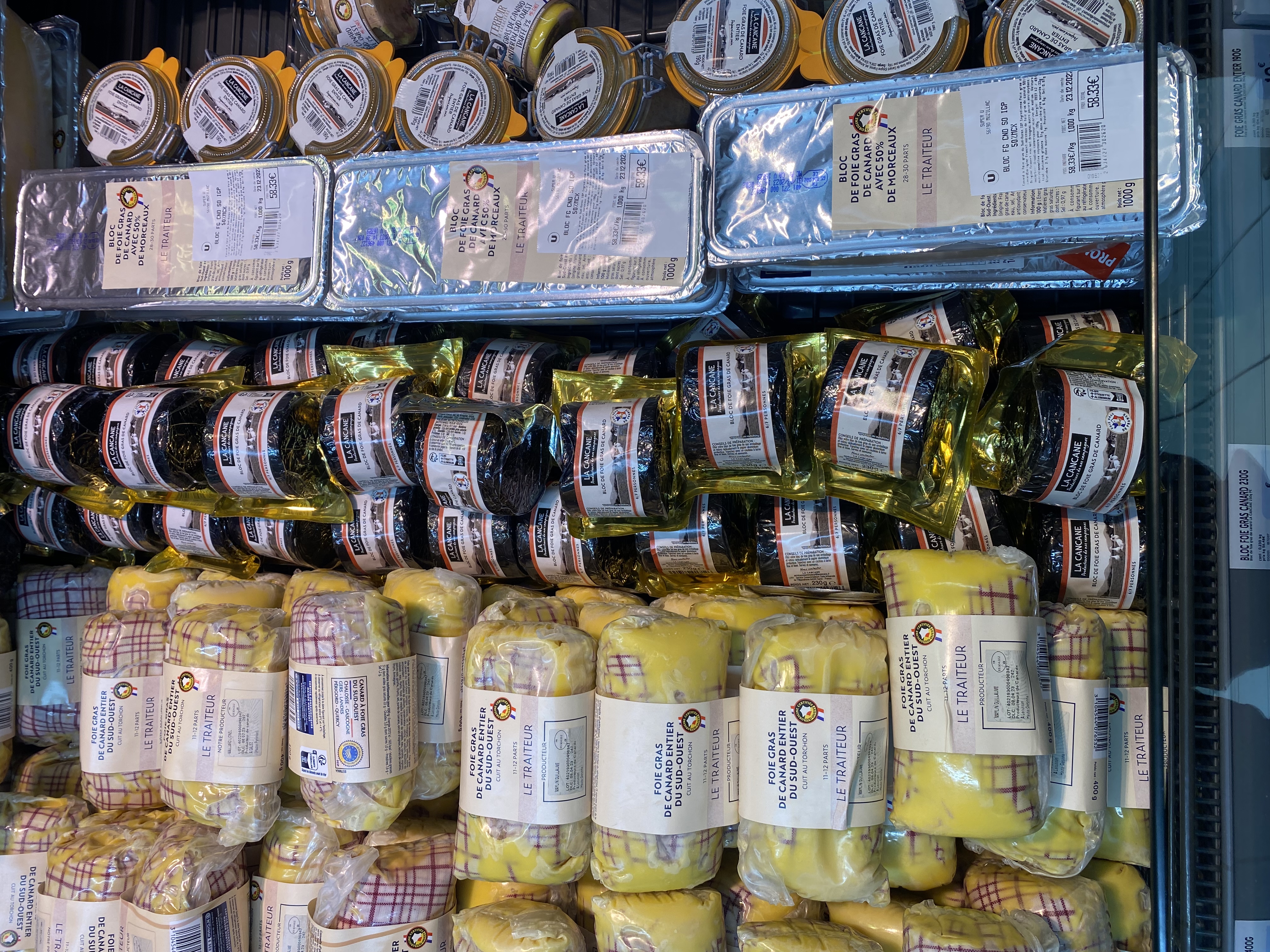
Yet if you walk into any French supermarket in December, you’ll find large sections devoted to foie gras, or “fat liver,” yet another term that sounds better in French. While it’s available all year, near Christmas, it’s everywhere. Foie gras is more popular in France than anywhere else in the world. They make more of it and they eat it more than anyone else. It’s a Christmas staple.
But that has changed a lot in recent years.
The evolution of fois gras
Foie gras’ origins go back to Egypt over 4,000 years ago, when farmers noticed that geese fattening up for migration were tastier. They refined a technique to fatten the birds intentionally and that process hasn’t changed much in millennia.
Foie gras relies on gavage, force-feeding of ducks or geese through a tube, causing their livers to swell. It’s an unhealthy, stressful process for the birds, who endure injuries and confinement for weeks.
From Egypt, the practice spread to Rome, where "iecur ficatum" (liver fattened with figs) evolved into the French foie and Italian fegato - a culinary connection predating the word itself.
By the 17th century, foie gras appears in French cookbooks, but it was still quite until after WWII, when the economic boom made it more accessible. Though considered a heritage food, it only became popular when more people could afford it.

Ethical considerations
Full disclosure: I’ve eaten foie gras recently, but I can take it or leave it—it feels like too much to put the ducks through. I’d rather just eat the duck itself.
People know how it’s made but often look the other way; I’ve done the same.
In 2014, France produced 19,000 tons (or the weight of 87 Statues of Liberty or 2 Eiffel Towers) of foie gras, using 81 million ducks and 2 million geese. Each bird can provide about 1 pound of foie gras, which is a lot for a duck weighing 6 lbs in total.
France makes and eats the majority of foie gras produced globally.
As of 2023, production and demand had dropped by half. A 2022 outbreak of bird flu contributed, but tastes and ethical concerns are changing. Despite declining French consumption, the market is growing, with U.S. demand up 10% and expansion expected in Asia.
The Future of Foie
Many French citizens support banning gavage and there have been some efforts to make fois gras more ethically. There’s a TED talk about that here.
Foie gras does not necessarily have to be any worse than eating meat: it’s gavage that’s the problem. Several cities have banned foie gras at official events, a mostly symbolic gesture as they weren’t serving it in the first place, but it marks a cultural shift.
New York City passed a foie gras ban in 2019, but it faced resistance from local producers and, yes, from France itself. Producers won a Supreme Court injunction to keep foie gras in NYC, citing risks to their businesses and the 1,000 restaurants serving it, or 5% of the city’s total of nearly 25,000. Losing NYC could cripple the U.S. industry, while France profits heavily from exports.
Plant-based versions are available with producers insisting that their products have the same texture and feel as animal-based products and meat eaters saying, well, no, they don’t. I’ve liked the ones I’ve had, but it’s not quite there yet. Still, I have bought much more veggie faux gras than fois gras. It’s a nice spread.

Lab-grown foie gras is expanding with companies like the Paris-based Gourmey (creating “cultivated meat delights,” “reimagining meat,” etc.). They’re creating a kind of 3-D printed foie gras and it has a lot of money behind it.
Cultivated meats like this are much more efficient in terms of land and resources and they’re likely to use less power as well in the near future. As more people are accepting lab-grown meat, it has a future.
At the same time, legacies can change. Plenty of once common delicacies like turtle soup, whale meat or peacock have become taboo. When I was a kid, Jell-O was everywhere, I probably haven’t eaten it since I was 9.
Fois gras may become one of those.