eating what you see - wild greens pistou
looking at our food differently - with a nice French pesto recipe!
What if the weeds were trying to feed you?
This started with bad soil, busted courtyards, and mulberries falling on the sidewalk. Not survivalism, but maybe a better, tastier salad and less time in the supermarket. Just noticing what still grows, and what no longer does. This is a messy look at foraging, food systems, and a recipe for a jar of very good green paste.
TL;DR: What Grows, Grows
This isn’t about prepping. It’s about looking differently. What still grows might be unfamiliar, opportunistic, alive. There’s a mixed greens pesto recipe in here too—simple, sharp, and green. Bring gloves.
for the record, I think doomsday prepping is a silly hobby.
You’re better off getting to know your neighbors than getting to be known as the guy with a bunker and a pallet of free-dried food.
Eat what you see
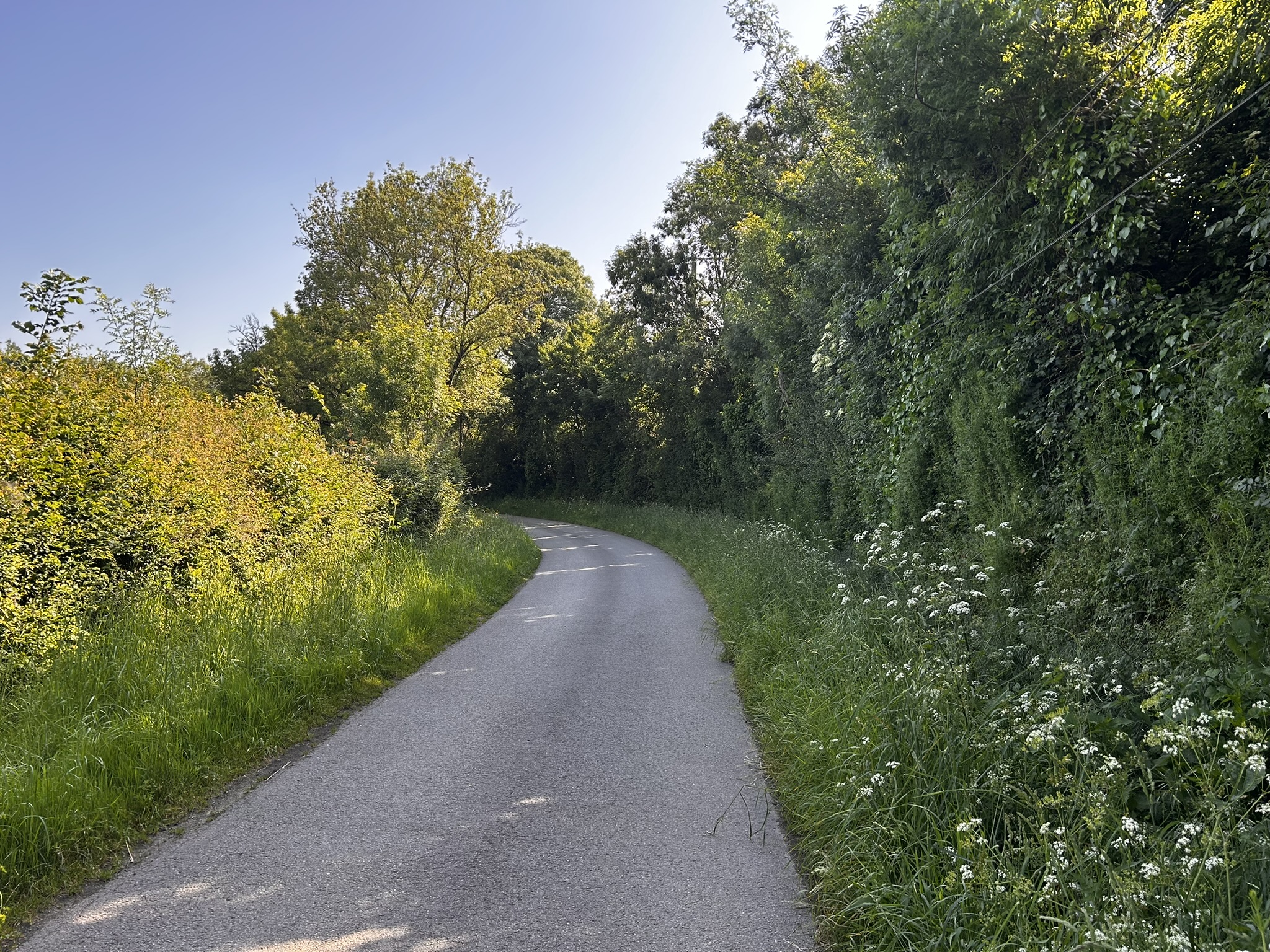
After years of trying to grow things in less-than-ideal situations—shaded courtyards, compacted schoolyard dirt, community gardens hemmed in by exhaust and broken fences—I started paying closer attention to what was already growing.
If something’s thriving in blasted soil, maybe something else can too.
I killed so many rosemary plants and bayleaf plants - babied them, really - but they died in New York anyway. They just couldn’t survive the winters and they are growing out of the sidewalks in France.
It’s easy to forget that this was the original food system: look around, eat what’s there. Learn slowly.
Cook what grows.
That’s what this is about. Not prepping for collapse. Not going “off-grid.” Maybe making a tastier salad or adding a bit more variety and green into your cooking.
The path forward might not be the path back. But it’s still a path. And it starts with looking down.
And maybe wearing gloves.
Stories, Food, Culture. Done Well.
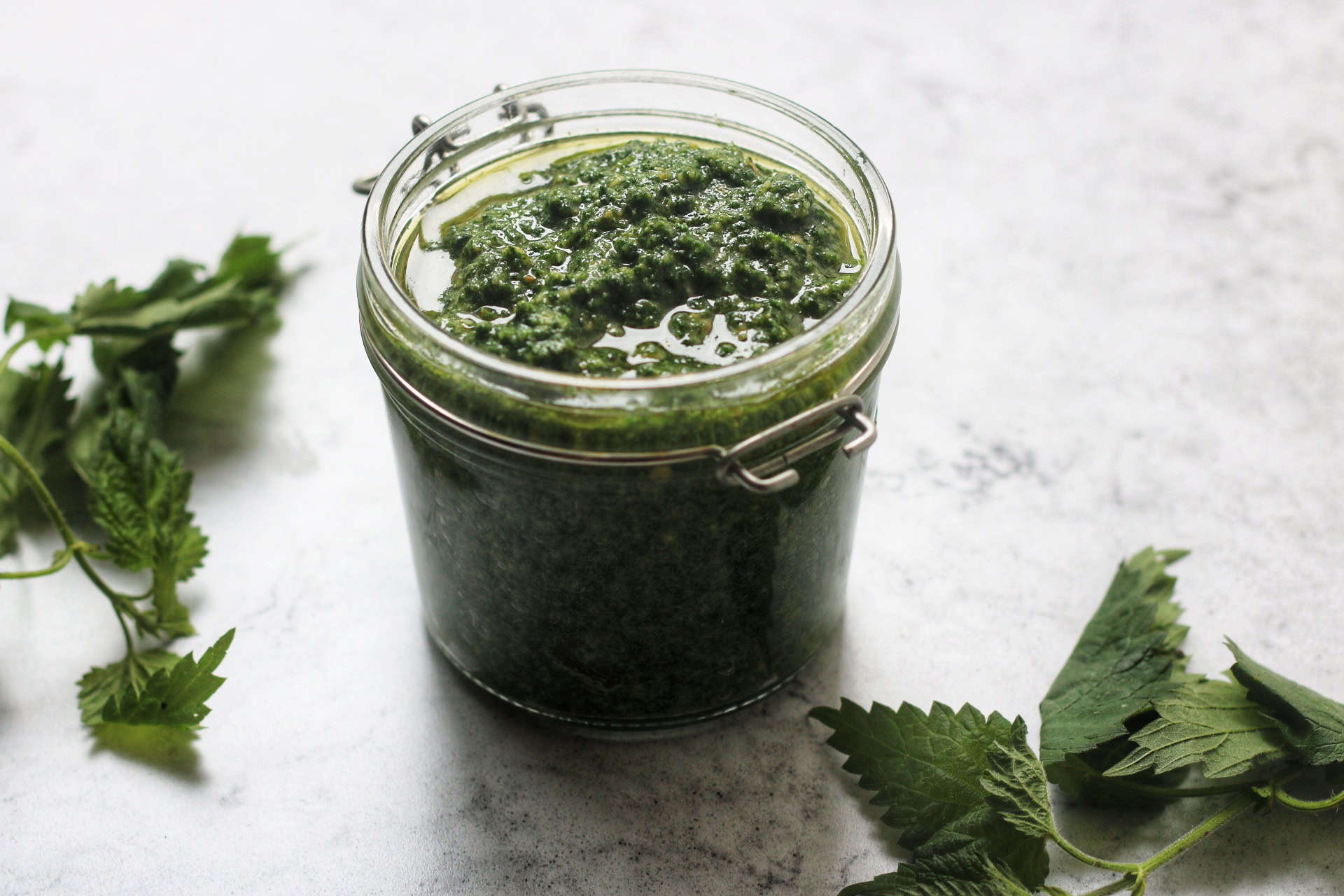
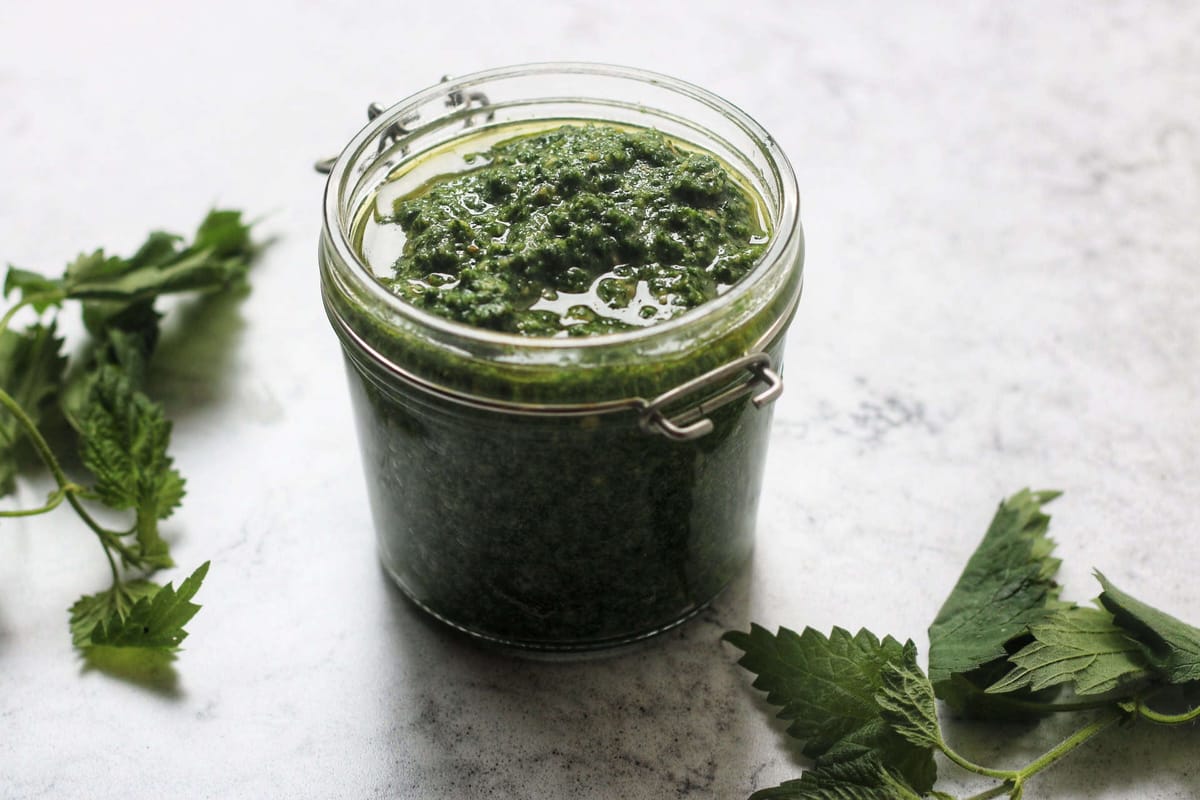
Nettle Pesto or pistou, depending
Pick a basket of young nettle tops (wear gloves). Rinse and blanch in boiling water for 1–2 minutes. Drain and cool. Squeeze out the extra water. Toss in a blender or food processor with:
- 1 garlic clove
- A handful of sunflower seeds, almonds, or pine nuts
- Grated hard cheese (Comté, Parmesan, or whatever you’ve got)
- A squeeze of lemon juice
- Olive oil (add slowly until it blends smooth)
- Salt to taste
Taste. Adjust. Spread on toast, stir into warm pasta, spoon over roasted veg.
Store it in a jar with a little oil on top. Keeps for a week, maybe more.
That’s it.
It’s not a revolution. It’s a jar of green paste.
But it’s a really nice green paste and it works on everything.
Tell someone to cook this for you.
Pesto vs. Pistou
Pesto is Italian—raw, green, bold. Basil, garlic, pine nuts, Parmesan, and olive oil crushed into a rich, punchy paste.
Pistou is its leaner French/Provençal cousin—no nuts, often no cheese. Just garlic, basil, and good oil. Simpler, thinner, but just as adaptable.
you can really stop now
I just out the recipe up top because I like it, but I hate scanning through people’s stories for recipes.
But if you want stories, keep going.
And there’s another good and flexible pesto recipe.
K
ignoring (some of) the signs
I used to teach kids about wild plants and foraging. Not all of them loved it, but even as a research project, it worked—got them out in the neighborhood, seeing things differently.
In Brooklyn, we’d spot mulberries growing wild, probably planted decades ago by someone’s grandmother. The birds took it from there. Everyone knew they were ready when the sidewalks started turning purple.
Once they understood one plant and started thinking about its cycles, they started looking into others.
It was a fine way to keep kids doing writing and research deep into June.
No dibs.
Sometimes it felt like there were more foragers than green spaces. Still, there was plenty to find.
People just got weird about it.
One of my favorite signs I ever saw was in Prospect Park, tucked into the oaks near the center. Handwritten, taped to a tree: “Don’t pick the Maitake!”
It didn’t feel official.
More like the latest in a long line of passive-aggressive notes from a neighborhood full of people who leave angry notes on windshields, dishwashers, hallway corkboards, telephone poles.
Anywhere someone needs to shake their tiny fists and Tell Someone Off.
Nobody reads them.
I hope they help people vent. I’ve never taken one seriously in my life—except in France for a hot second. But now I don’t do that here either.
I scoff. And I don’t scoff easily.
The sign felt more like someone trying to mark their territory. But in a dumb way.
Sorry, buddy. You don’t get to call dibs on mushrooms. Not when we’re all technically breaking the law anyway.
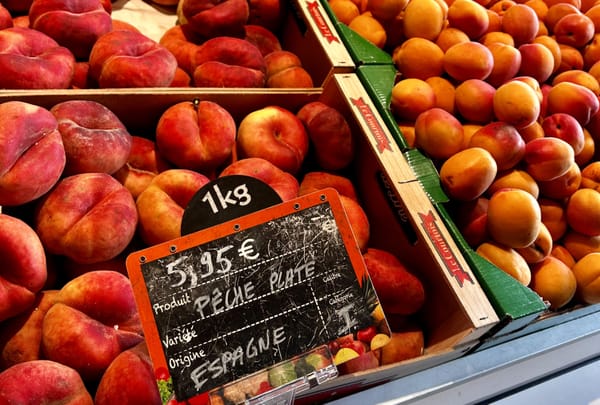
we had to learn what’s in the markets, too
Foraging in NYC parks is illegal. I know three people who’ve been arrested for it—same three got fined, too. They kind of asked for it, to be fair. Loved bothering the cops. But most of the time? No one cares.
I ignored the sign, moved through a hole in the fence and into the oaks. It was October when things were getting chilly at night. This was a good spot for those mushrooms.
I gathered a bunch, brought them home and sauteed them with butter and nori and basked in my success.
There was food all over, if you knew how to see it. If you were willing to look at the city differently.
I never saw this as survivalism. I still don’t. That whole fantasy of rugged independence misses the point. Those emergency kits—freeze-dried, vacuum-sealed, packed for the apocalypse—they’re still only good for a year or two.
And really, I don’t know what kind of apocalypse1 everyone’s prepping for, but I’m willing to bet there’ll still be plants around—and if there aren’t, well, that’s a different kind of problem.
Back to nettles.
They grow everywhere. They sting, sure. That keeps the casual hands away.
But they’re easy enough to cook, easier than a lot of foods we eat without thinking. I mean, most people don’t eat raw potatoes for good reason.
Plenty of folks have strawberry allergies, but that doesn’t mean that nobody eats strawberries, and so on.
So if you’re trying a new wild food, take it slow. See how your body reacts.
Let your kitchen be a lab: a simple application of the scientific method can open up your dinner plate.
And that’s the real difference between the old way and whatever comes next. The new world isn’t going to be stocked and branded. I don’t think it is all going to collapse like some folks fantasize.
I think the future will be relatively less convenient.
It’s going to be opportunistic. Local. Messy. Alive.
And yet so much of what we believe—about food, about land, about what’s worth preserving—is tied to a version of the past that feels solid but isn’t. France in particular has a deep attachment to its culinary geography. The AOCs, the AOPs, the protected origins, the terroir. It’s comforting, in a way. To believe that if you follow the names, you can still taste history.
But what happens when the place no longer matches the name?
That’s already happening. Cows eat different grasses because its drier. Caves are too warm. Grapes come early.
…And the idea that a certain natural product can only come from a specific are starts to more than just nostalgic, but unrealistic.
Which brings us back, again, to nettles, and to other random greens as well.
So here’s one thing you can do:
- More stuff about climate. 😐
- but another nice pesto! 🙂
inventory is delicate; weeds aren’t
The latest climate models suggest that Europe is warming 2-3x faster than the global average. France is losing 5% of its agricultural surface water annually. In 2023, nearly 90% of French wine regions reported irregular flowering due to seasonal disruption. Meanwhile, in the U.S., the average distance food travels before it gets to a plate is still over 1,500 miles.
All of this sounds technical until it doesn’t. Until you’re standing in a shop staring at tomatoes from somewhere you only know about because it was on fire recently.
In France, food insecurity is less visible, but it's creeping in. France has its own inflation issues to be concerned about. These are not just concerns of terroir or seasonality: we’re pushing the limits of supply chains.
But all of that is actually quite new.
Food, Music, France - 3x a week.
Un banc, un arbre, une rue Séverine (1971)
Un banc, un arbre, une rue by Séverine won 1971’s Eurovision - but representing Monaco, not France - a lush, nostalgic ballad that ties memory and identity to simple, grounded images—a bench, a tree, a street, etc. Emotional, polished orchestration and poised theatricality that can really bring home that glass microphone.
I grew up with Cap’n Crunch. My parents didn’t.
What still grows where we are isn’t just about plants. It’s about stability. About how long the rules hold.
France clings to food heritage like a lifeline. The AOP system ties whole regions to single products—Comté must come from Comté, Champagne from Champagne.
But Champagne’s not what it used to be. Vines ripen too fast. Cows graze on different grass. Rain doesn’t fall when it should.
The idea that terroir is fixed—rooted in place, in tradition—that story was written before climate change hit full speed. And like a lot of stories lately, it’s wilting at the edges. Wasn’t all that old to begin with.
In the U.S., the myth was always about choice. Strawberries in winter? Sure. A lawn in the desert? Why not. But choice only works when the system underneath is steady—labor, trust, time.
Without that, it’s just inventory.
And here’s the thing about inventory:
It breaks.
Systems stall.
Trust thins.
Or in France, maybe there’s a protest and nothing moves for a week.
And still—the nettles keep growing.
It sounds simple. Maybe it is.
And not all change means that something is lost.
So here's something to do with what still grows here.
Recipe: Spring Greens Pesto (with Nettle, Again)
This one’s flexible. The only rule is: use what you have.
But use some good oil, if you can.
remove the cheese and nuts and you have French Pistou2
Ingredients:
- 1 large handful young nettle tops (blanched for 1 minute and drained)
- 1 handful of any other spring greens: arugula, spinach, parsley, wild garlic, dandelion, wall lettuce
- ½ cup walnuts or sunflower seeds
- 1 clove garlic
- Juice of ½ lemon
- ¼ cup grated cheese (hard and salty is best)
- Olive oil (start with ¼ cup and add more as needed)
- Salt to taste
Instructions:
- After blanching nettles, squeeze out extra water.
- Toss everything in a blender or food processor.
- Blend until smooth. Taste. Adjust. Add more oil or lemon if needed.
- Store in a jar with a little oil on top. Keeps for about a week.
Spoon over toast, pasta, roasted potatoes, or stir into soup.
It tastes like spring.
If you’ve been thinking about what still grows—and what’s not growing so well anymore—pass this along. Share it with someone who watches the weeds.
I’m always curious what plants are speaking to other people right now.
I mean that fuguratively.
k
extra stuff
Some herbs to check out
Yarrow
yarrow grows all over and is a real survivor. Use it like an herb, not like a lettuce.
Strong and perfumey, like rosemary, resin, even camphor. Use sparingly, but it’s a nice addition.
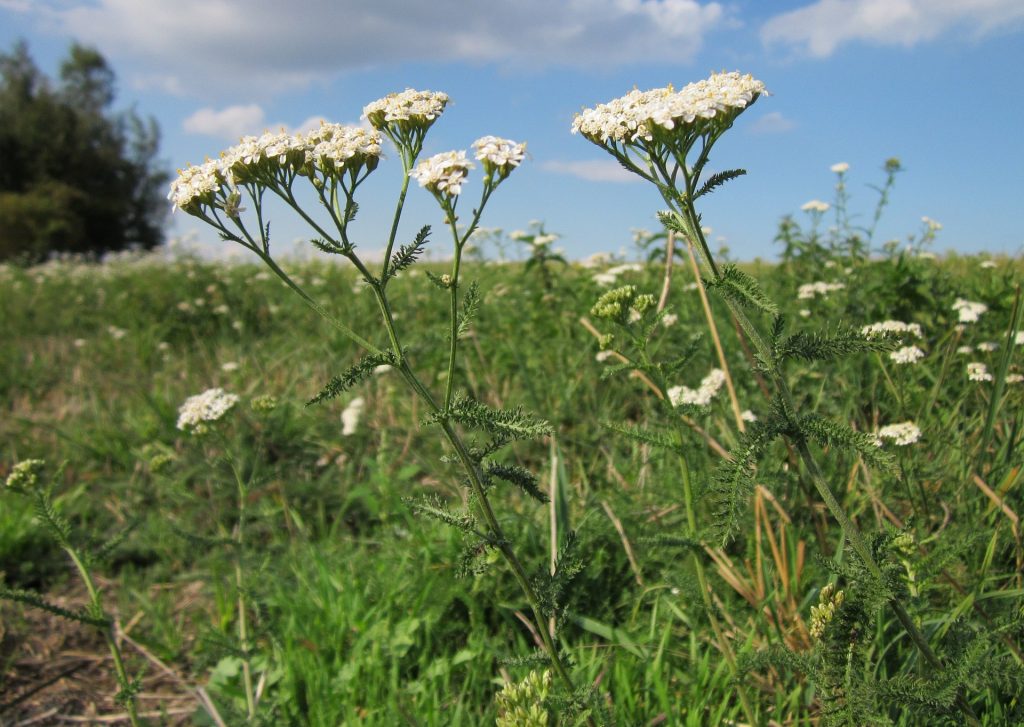
It is a perennial plant, it forms tufts and lines the soil. These leaves are dark green measure from 2 to 15 cm and are thin. These flowers are small, white, pink, or purple. It slightly smells like camphor.
cleaning greens
An interesting technique I’ve seen more in France is to take your herbs and rinse them off in vinegar water and then add them to whatever you’re doing.
I haven’t messed with it much myself, but I have added a bit of vinegar to pestos like this to deepen flavor.
I am more of a zombie apocalypse fan. Stick with a group, keep moving. Never betray the group. ↩
Pesto is Italian—raw, green, punchy, typically with basil, garlic, pine nuts, Parmesan, and olive oil, crushed together.
Pistou skips the nuts and often the cheese, focusing on garlic, basil, and olive oil. Simpler & thinner, but equally flexible ↩