Orange Blossom's "Di Ya Sîdî": Arabic Vocals Meet French Electronics in Nantes
How a French electronic group found their sound by weaving together musical traditions
While Paris dominated France's cultural landscape, the port city of Nantes quietly cultivated something different—a grassroots scene built on shared cassettes, converted warehouses, and for some, a kind of patient experimentation that major labels tend to overlook.
Orange Blossom emerged from Nantes in the 1990s, evolving from a local trip-hop experiment into an internationally acclaimed fusion of electronic beats and traditional Arabic vocals.
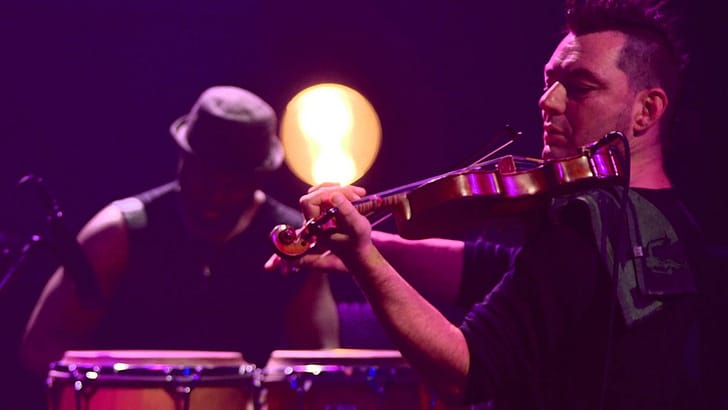
Their track Di Ya Sîdî from Under the Shade of Violets layers Hend El Rawy's vocals over Carlos Robles Arenas' percussion and PJ Chabot's violin, with gothic depths reminding me of artists from 4AD.
Di Ya Sîdî Orange Blossom (2014)
I prefer the live version – and I don’t have to spend so much time looking at Gerard Depardieu (it’s below for the fans that remain).
Di Ya Sîdî, released on Under the Shade of Violets, feels older to me - I thought it was a cover song at first, but the writing is likely rooted in Egyptian vocalist Hend El Rawy’s deep study of traditional Arabic music.
Orange Blossom is the vision of Carlos Robles Arenas, a Mexican composer based in Nantes who has drawn on Turkish, Egyptian, Malian, Senegalese and Cuban traditions, with voices sung in Arabic, Persian and Portuguese. The band is composed of immigrants from around the world - and people you’re very likely to see and hear in Nantes.
They’re currently on tour.
I love this. They’ll love this.
Di Ya Sîdî Orange Blossom (Official - for Marseilles)
The lyrics below are sourced from fan translations and AI guesses. It may not reflect the artist’s intent exactly.
Sadly, I don’t speak Arabic and can’t offer my own translation.
I will not allow you to hurt my feelings
Or amuse yourself with my name
I will not allow you to define my dignity
Or use it as a cheap way to express feelings
Even if my heart goes astray, even if it cries “ah”
As long as there is life between us
My heart refuses to listen to you
Lord, Lord, Lord, Lord, I’ve repented, oh Lord
Even if my heart cries “ah”
…My heart refuses to listen to you
Lord, Lord, Lord, Lord, I’ve repented, oh Lord
Cassette culture
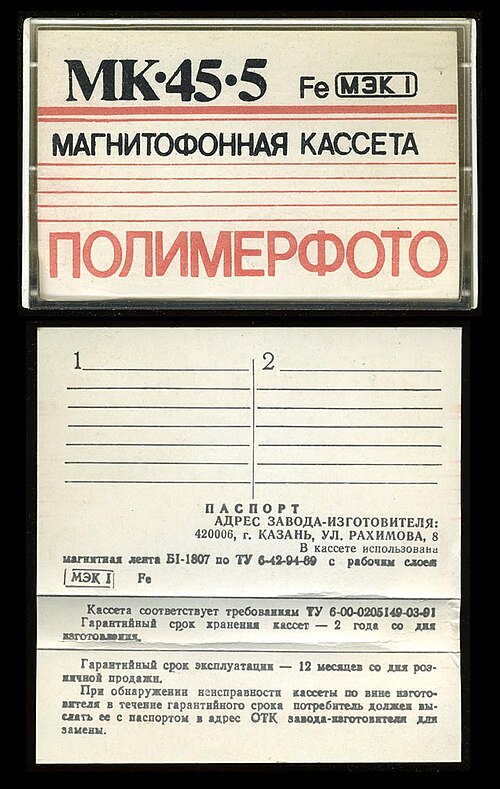
Orange Blossom evolved this track through years of musical experimentation and collaboration as new members joined and their style evolved. They started out playing small shows and recording and distributing their music through grassroots cassette swaps.
Nantes’ cassette culture was a grassroots scene built on swapped tapes, handwritten tracklists, and zine ads taped to light poles. Orange Blossom’s first CD was eventually released in 1995 on the Russian-named French indie label Prikosnovénie (“light touch”), itself maybe an allusion to the tape recorder movements of Russia (maybe).
Oddly, Prikosnovénie was a bit better known for producing elven- and Lord of the Rings-style artwork than it was for making music.
Orange Blossom’s first CD sold 15,000 copies.
Not all roads lead to the capital.
Nantes had its own music scene & still does.
Shipyards that once built warships now host mechanical elephants. Biscuit factories became art centers. The city took the leftovers of its industrial past and reanimated them into stages, squats, festivals, and studios. Nantes didn’t erase its history. It remixed it.
Di Ya Sîdî feels like it was recorded in one of those reimagined spaces—a warehouse with rusted bolts still in the beams, acoustics that change.
Music, Culture, France you won’t find in other places. Every week in your inbox.
Habibi (2005)
Habibi is a bit closer to their triphop sound, to give a sense of what else they were doing.
I’ve got it on tape
The tape recorder revolution happened in Russia and the former Soviet bloc for many years, almost immediately following the invention of reel-to-reel recordings. As the technology became more available, people swapped more and more music this way, allowing artists like Vladimir Vysotsky (who I love) to develop a massive fan base despite Soviet era prohibitions.
So you make the music yourself, copy it and pass it hand to hand, let the tape do what the industry won’t. In the USSR, it was magnitizdat, smuggling forbidden songs.
In Nantes, it was café gigs, dubbed demos, zines taped to lampposts. Not censorship—just distance. Just the sense that no one in Paris was listening.
But someone, somewhere, might. So you record. You copy. You pass it on.
Anyone remember Nantes in this era? Have you seen Orange Blossom? Have you got your own tape recorder revolution? I’d love to hear it!
Moscow-Odessa Vladimir Vysotsky (1960s)
I love Vladimir Vysotsky, who is probably one of the most famous of the Russian bards who came to prominence during the Soviet era.
This song captures the frustrations of Soviet air travel, following a narrator repeatedly delayed on flights between Moscow and Odessa who finds himself charmed by a flight attendant. The track showcases Vysotsky's ability to find humor and human drama in everyday Soviet life, turning mundane experiences into compelling narratives through his distinctive gravelly voice and theatrical delivery. While this isn’t one of his more revolutionary tracks, it remains one of his most popular.